

© 2026 All Rights Reserved. 粤ICP备14051456号
2021-05-22
View:5
Recently, Professor Hailong Li from the School of Environmental Sciences and Engineering at the Southern University of Science and Technology (SUSTech), in collaboration with an international research team including scientists from the University of Gothenburg, Leibniz Centre for Tropical Marine Research (ZMT), and Westlake University, published a paper in Nature Reviews Earth & Environment, entitled “Submarine groundwater discharge impacts on coastal nutrient biogeochemistry”. This paper evaluates the results of numerous studies, quantifies nutrient fluxes from groundwater inputs, and explains their effects on marine ecosystems.
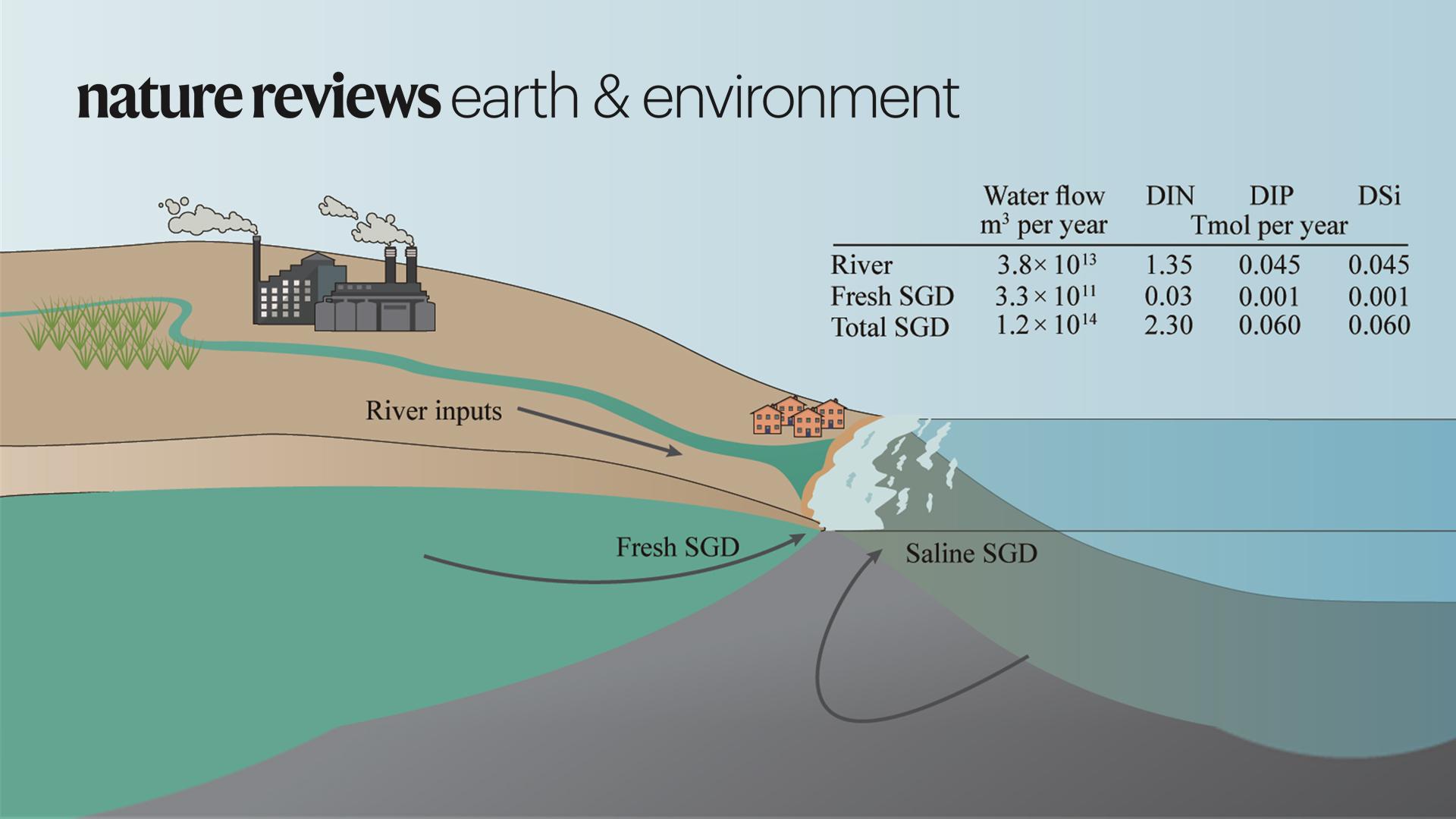
Water quality management in the ocean often targets visible pollution sources such as rivers, atmospheric deposition, and sewage. But nutrients also enter the oceans through groundwater. The importance of Submarine Groundwater Discharge (SGD) has often been overlooked in comparison to other sources mainly because the discharge occurs below the water surface and cannot be easily observed and measured. Quantifying SGD-derived nutrient fluxes is therefore challenging and involves nuanced assumptions and interpretations, and a wide range of skills in oceanography, hydrology, and biogeochemistry.
This paper evaluates the results of numerous studies. They were conducted at more than 200 sites in coastal areas worldwide, ranging from polar to tropical seas (Figure 1). Of the locations investigated, around 60% of the studies showed that nutrients such as nitrogen, phosphorus, and silicon enter the sea in greater quantities via groundwater than via rivers, the largest sources of nutrients in the oceans (Figure 2). This makes groundwater the most important nutrient supplier to coastal ecosystems at many coastal locations. Projections show that groundwater worldwide releases around 140 million tons of silicon, 40 million tons of nitrogen, and 9 million tons of phosphorus into the sea each year.
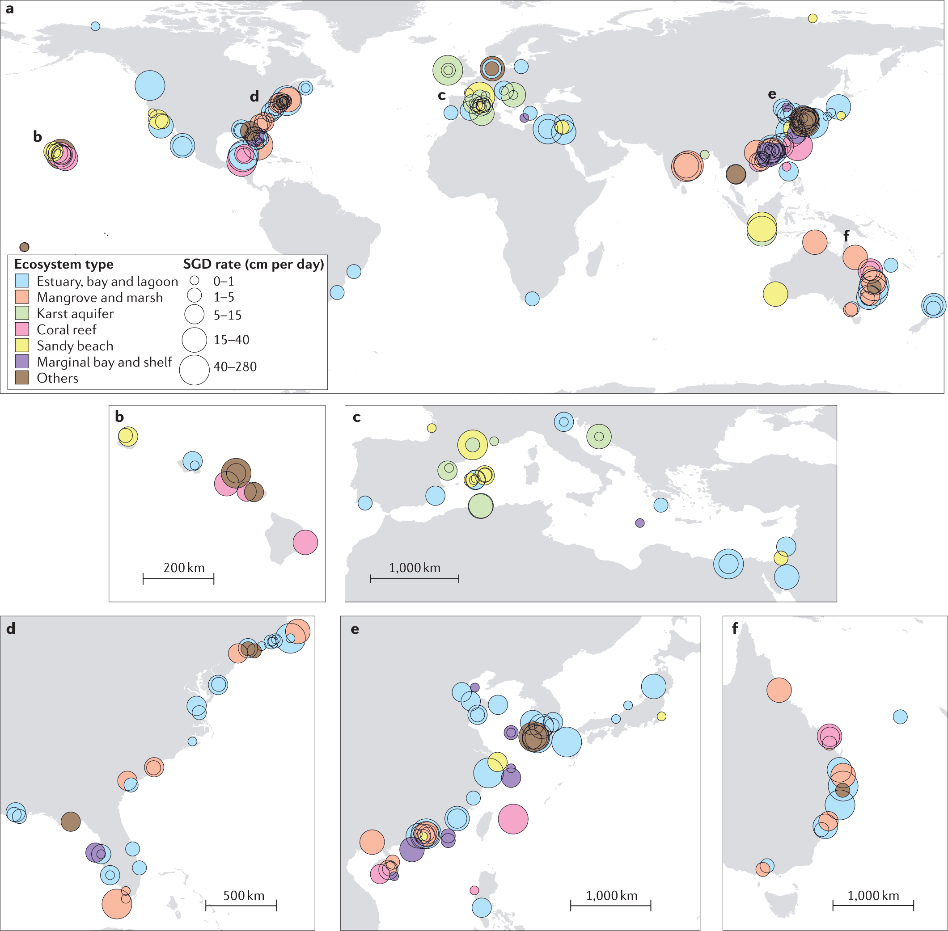
Figure 1. Submarine Groundwater Discharge (SGD) rates from study cases reviewed. (a) SGD fluxes globally, color-coded by ecosystem type, where the size of the circle represents the reported SGD rate. Similar maps for each nutrient are shown in the supplementary material. Investigations where SGD rates are reported without any nutrient fluxes were not included in the compilation. (b) SGD in Hawaii, USA, with ecosystems colored and rates scaled as above. (c) SGD in the Mediterranean. (d) SGD on the east coast of the USA. (e) SGD in East Asia. (f) SGD on the eastern coast of Australia.
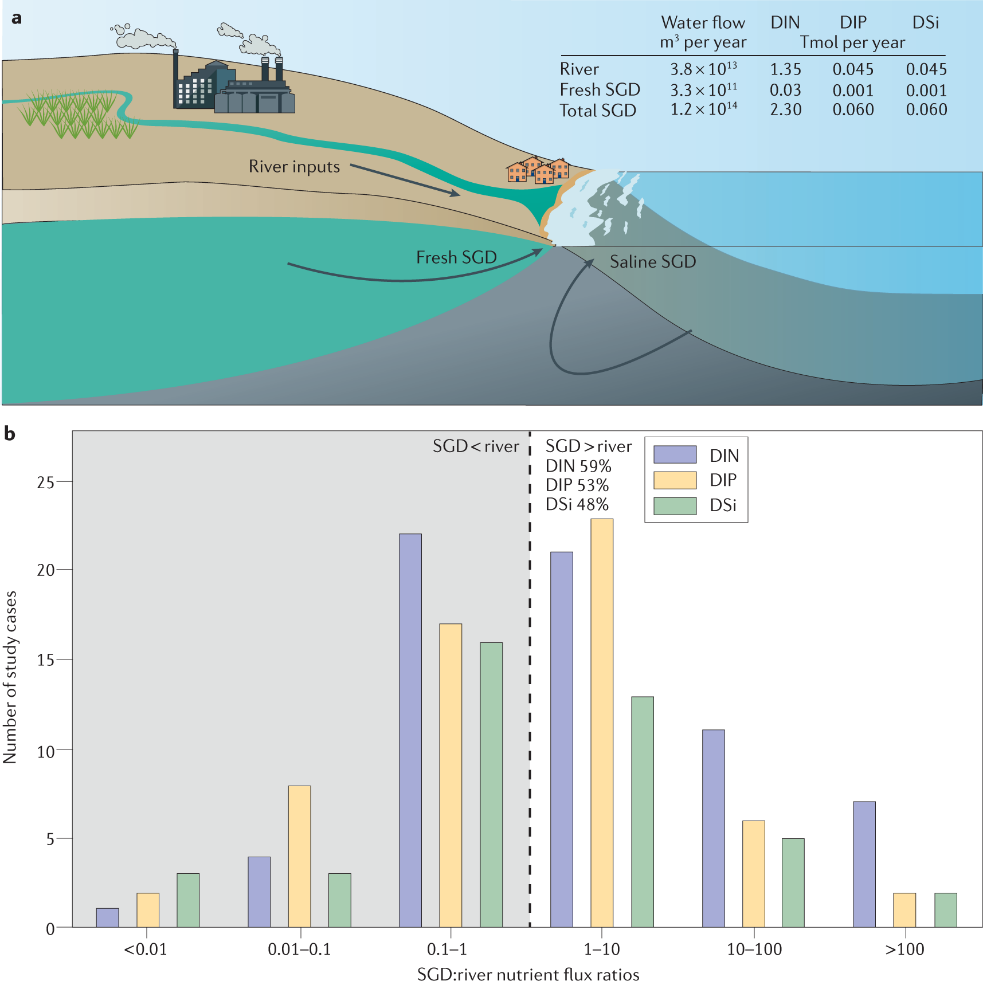
Figure 2. River and SGD-derived nutrient inputs to the ocean. (a) Summary of global-scale fluxes compiled from the river, Fresh Submarine Groundwater Discharge (Fresh SGD) and total (mostly saline) SGD estimates. (b) Histogram of ratios between SGD and river-derived dissolved inorganic nitrogen (DIN), dissolved inorganic phosphorus (DIP), and dissolved silicate (DSi) fluxes summarized from the global study cases reviewed.
SGD consists of a mixture of continental fresh water and saltwater that permeates from the coastal aquifer. It is an invisible hydrological link between coastal aquifers and the sea. In addition to supplying fresh water to the sea or other coastal systems (lagoons, wetlands), SGD can represent an important source of nutrients for these ecosystems. Therefore, SGD plays a critical role in their sustainment and, consequently, on the goods and services provided by these ecosystems. Due to this underground connectivity, any anthropogenic impact on coastal groundwater, such as pumping water, the use of fertilizers, or the infiltration of urban water into aquifers, can affect the transfer of nutrients to the ocean.
SGD-substance inputs can be a blessing or a curse for coastal ecosystems. For example, coral reefs can benefit from the fact that carbonate dissolved in groundwater promotes coral calcification. An example of this would be the nutrient-rich groundwater sources of Australia’s “Wonky Holes”, which are hotspots for fish such as giant bass and, highlighting the importance for fishing and tourism. However, there are also negative impacts of groundwater flows on coastal ecosystems. In many places, excess nutrients lead to overfertilization of water bodies and to algal blooms (Figure 3). Such negative effects of nutrients are seen off the coast of Hawaii where the U.S. Supreme Court also recently ruled that groundwater must be better protected to guard the coastal ocean.
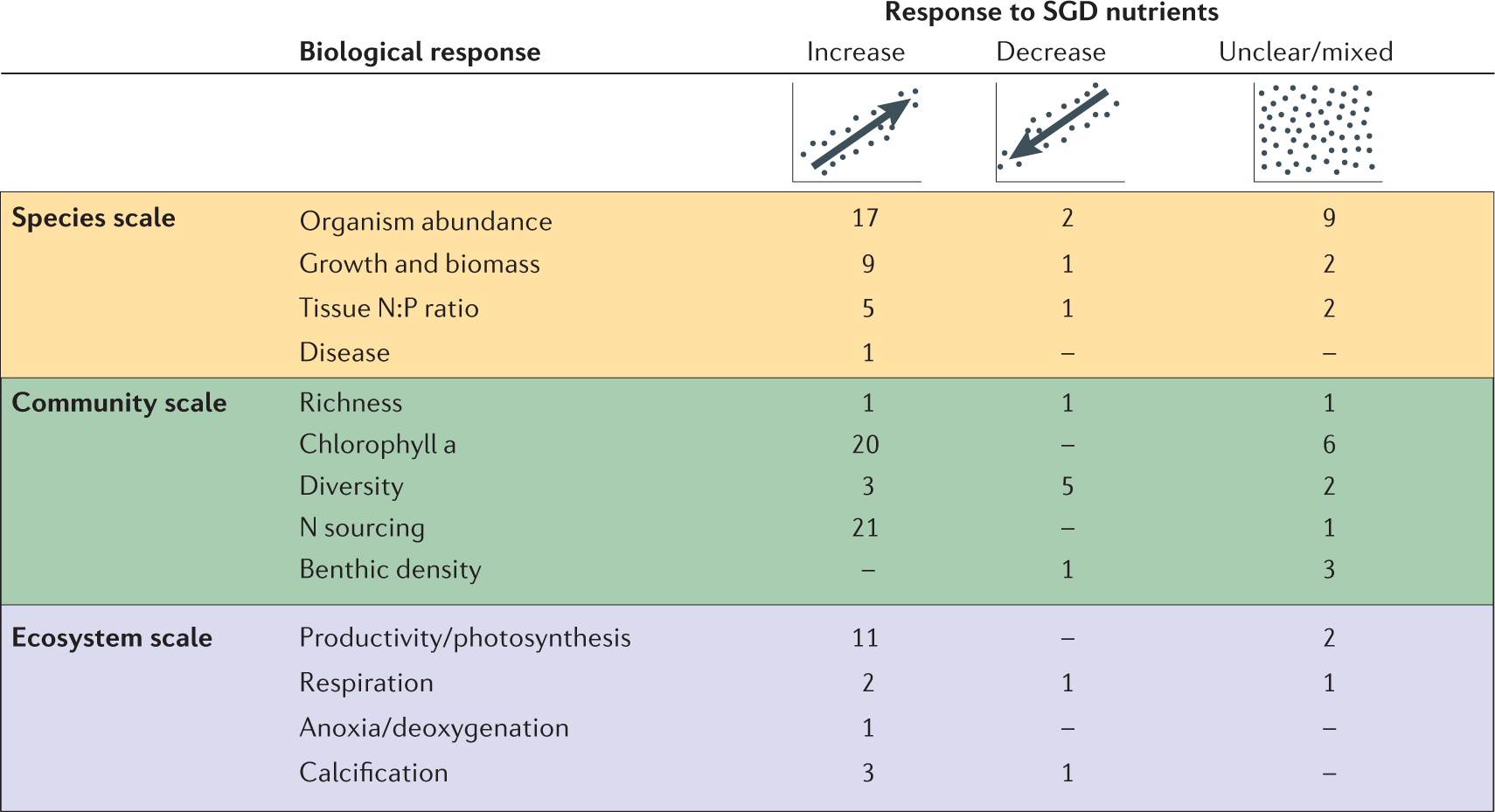
Figure 3. The biological impacts of SGD
Understanding the delivery of anthropogenically-derived nutrients to the coastal ocean through groundwater discharge is, therefore, crucial to ensure appropriate management of coastal waters. Researchers consider that, unfortunately, since SGD is essentially invisible and highly variable along different coastlines, decision-makers face two opposing risks; ignoring a potentially important pollution source or wasting resources on a potentially small source. In addition, since the role of SGD in ecological, economic, and societal context is not appropriately constrained, management strategies and policies cannot become effective.
Climate and land-use change are expected to modify patterns of global water use, drive sea levels to rise, force seawater infiltration into coastal aquifers, and modify the chemical composition and volume of groundwater. These changes are expected to modify fluxes of nutrients from SGD, but little is known on how increased anthropogenic pressures will modify the quality and quantity of groundwater fluxes to the ocean. In addition, the slow movement of SGD relative to rivers implies that current contaminant and nutrient flows reflect past inputs, and management approaches must prepare for increasing loads in the decades to come. A proper understanding of their role in the ecological and economic context is needed to develop effective coastal management strategies.
The joint study was led by Professor Isaac R. Santos at the University of Gothenburg, Sweden. Professor Isaac R. Santos is the first and corresponding author of the paper. Professor Hailong Li from the School of Environmental Sciences and Engineering at SUSTech is a member of the international team that authored this paper. His research was supported by the National Natural Science Foundations of China (NSFC) (41972260, 41430641).
Paper link: https://doi.org/10.1038/s43017-021-00152-0
2026-03-10
2026-09-08
A delegation of 13 students from Southern University of Science and Technology (SUSTech), Zhejiang University and the University of Science and Technology of China (USTC), accompanied by four SUSTech faculty members including including two affiliated with the State Key Laboratory of Soil Pollution Control and Safety, concluded a 12-day summer school at Flinders University in August, 2026, hosted by the University’s National Centre for Groundwater Research and Training (NCGRT).Throughout the program, the students participated in a wide range of educational activities covering water resources, environmental health, groundwater modeling, managed aquifer recharge, salinity management, mining sites management, virtual reality hydrology, and nature-based solutions for surface water, groundwater and soil pollution.A highlight of the visit was a series of field trips showcasing South Australia’s unique natural environments. These included an overnight excursion to a global showcase of integrated surface and groundwater management exemplified by the Murray-Darling Basin. Visits to the St Kilda Mangroves highlighted ecohydrological approaches to coastal mangrove conservation. While Hallett Cove featured the most famous glacial striation on pre-Cambrian rocks. Happy Valley Reservoir, Oaklands Wetland, and Port Willunga Beach, with their wildlife, water management and well-exposed sedimentary rock formations, left strong impressions on our students. Students also attended research seminars and explored Flinders University’s teaching and research facilities.This summer school provided an excellent opportunity for students to engage with Flinders University staff, students, and researchers, experience Australian approaches to soil and groundwater pollution control and safety research, and strengthen the institutional ties between SUSTech and Flinders University, while fostering international connections and cross-cultural learning. The visit was made possible through a combination of support provided by SUSTech and the Fundamental and Interdisciplinary Disciplines Breakthrough Plan of the Ministry of Education of China(JYB2025XDXM909).During the visit, Chair Professor Yan ZHENG from SUSTech delivered a research seminar on arsenic detection in the developed and developing world. Flinders University noted that its academic community was privileged to learn from her expertise.SUSTech expresses its gratitude for the incredible partnership with Flinders University at the conclusion of the program.
2026-04-22
On April 22, the Frontiers Planet Prize announced its list of 25 National Champions for 2026. Hong WANG, a 2025 graduate of the School of Environmental Science and Engineering at the Southern Universi
2026-04-20
On the morning of April 17, 2026, a delegation from Flinders University (Australia), led by Professor Colin Stirling, President of Flinders University, visited the Southern University of Science and T
2026-04-08
Hydrological models are foundational tools for water resource management, agricultural planning, flood and drought mitigation, and ecosystem protection. A long-standing challenge in hydrology is devel
 |