

© 2026 All Rights Reserved. 粤ICP备14051456号
2021-09-16
View:5
The increasing microplastic pollution, together with the plastisphere-associated ecological threats in coastal areas, have aroused global concern. Tropical cyclones have increased in both frequency and intensity under global warming, causing an intense impact on the microplastics distribution and the structure of coastal ecosystems. However, until most currently, the extent to which typhoon impacts the microplastics and plastisphere community remains poorly known.
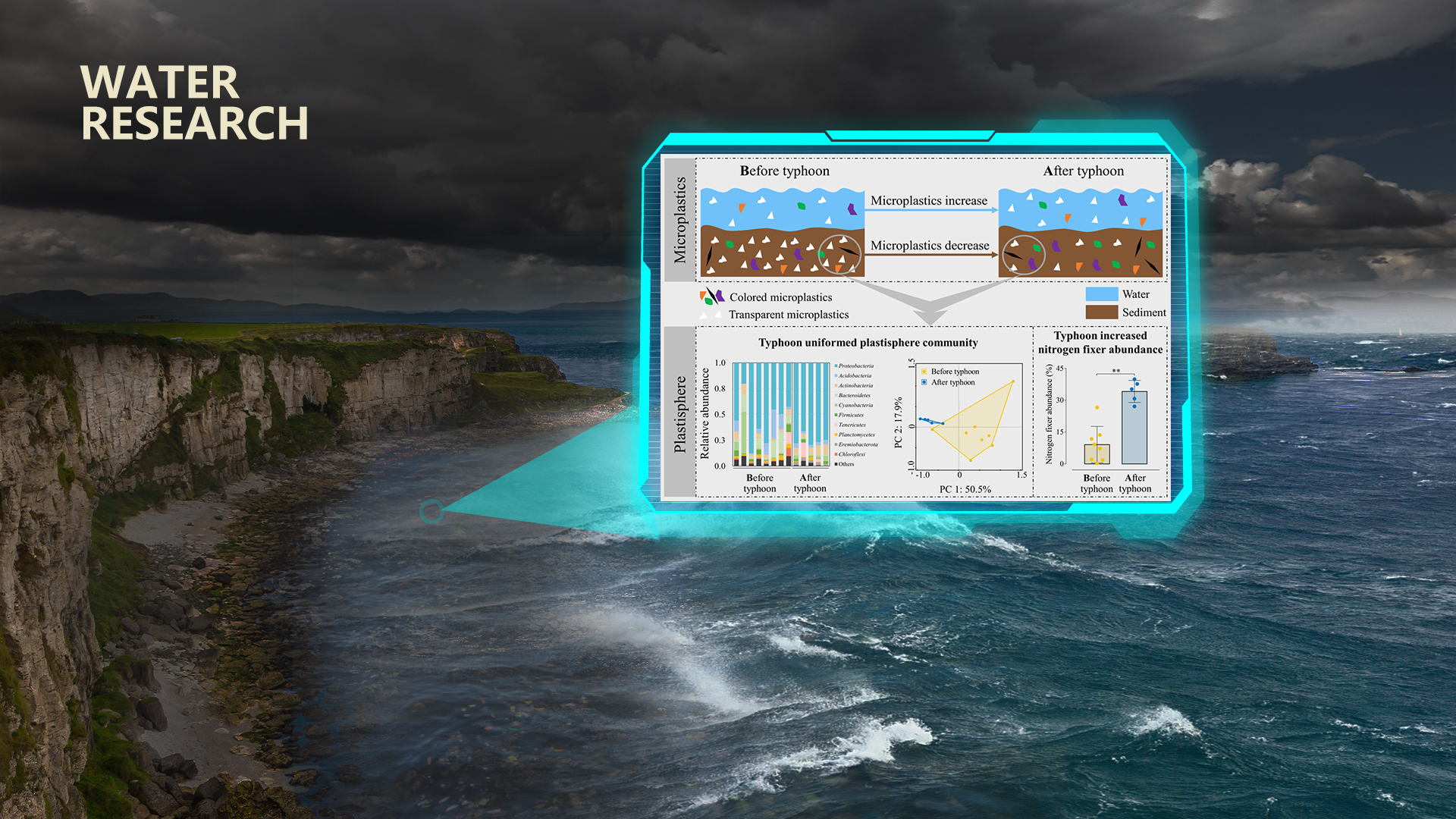
Recently, researchers from the Southern University of Science and Technology (SUSTech) published a paper on the subject. Their study, entitled “Typhoon-induced turbulence redistributed microplastics in coastal areas and reformed plastisphere community,” was published in the journal Water Research.
The emergence of plastic has provided huge social benefits but also brought serious environmental problems. Due to the long half-life and the hydrophobic surface of plastics, it is generally believed that microplastics can be served as vehicles to promote microbial colonization and biofilm formation, the so-called “plastisphere”, and eventually become a pelagic habitat for microorganisms. At the same time, microplastics provide more ways for the long-distance transmission of potentially pathogenic microorganisms, posting ecological impacts on the original ecosystem.
Extreme storm events, such as tropical cyclones (i.e., tropical storms and typhoons), can significantly affect coastal ecosystems. However, limited studies have been conducted to investigate the effect of typhoons on microplastic abundance, composition, and distribution to date. Given the growing ecological concerns aroused by increasingly frequent and severe tropical cyclones, such effort is of no doubt inadequate to clarify the impacts of typhoons on the coastal microplastic distribution.
Furthermore, even though plastisphere has been recognized to modify the environmental fate of microplastic particles, no study has demonstrated the influence of typhoons on plastisphere to date. Therefore, more research is urgently needed to better understand how typhoons impact the microplastic distribution in the environment and ultimately impact ecosystem function by regulating plastisphere composition.
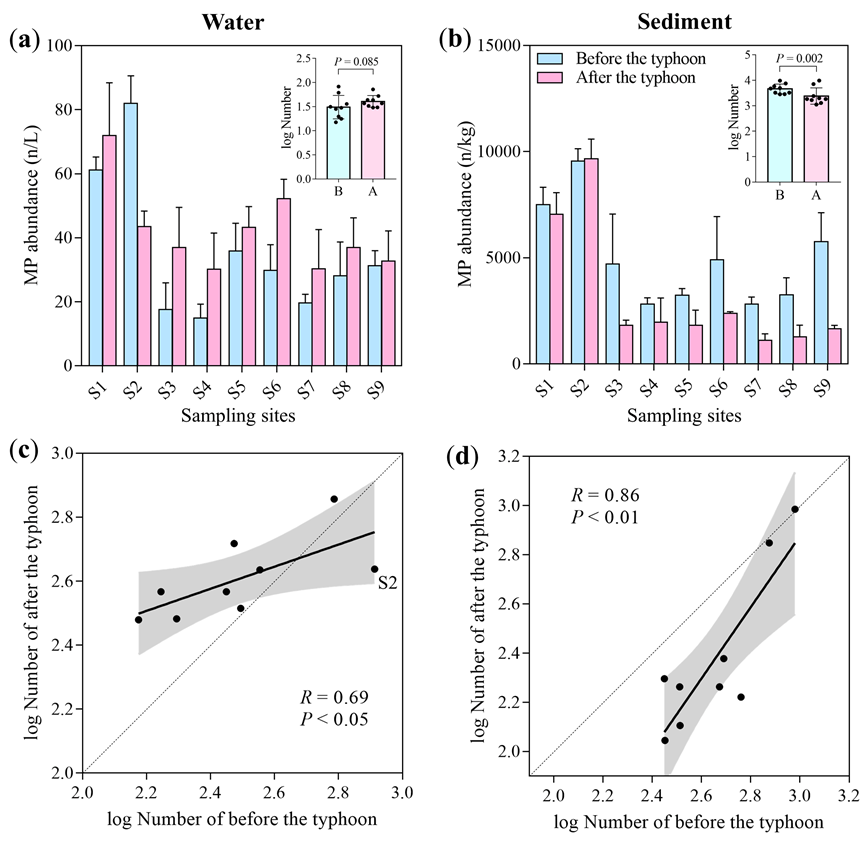
Figure 1. Mean (±SD) abundance of microplastics in surface water (a) and sediments (b) collected in Shenzhen coastal areas before and after a typhoon (B: before the typhoon; A: after the typhoon). The bar plot at the upright corner shows differences in microplastic abundance before and after typhoon (paired-sample t-test). Correlation analysis of microplastic abundance in surface water (c) and sediment (d) before and after the typhoon.
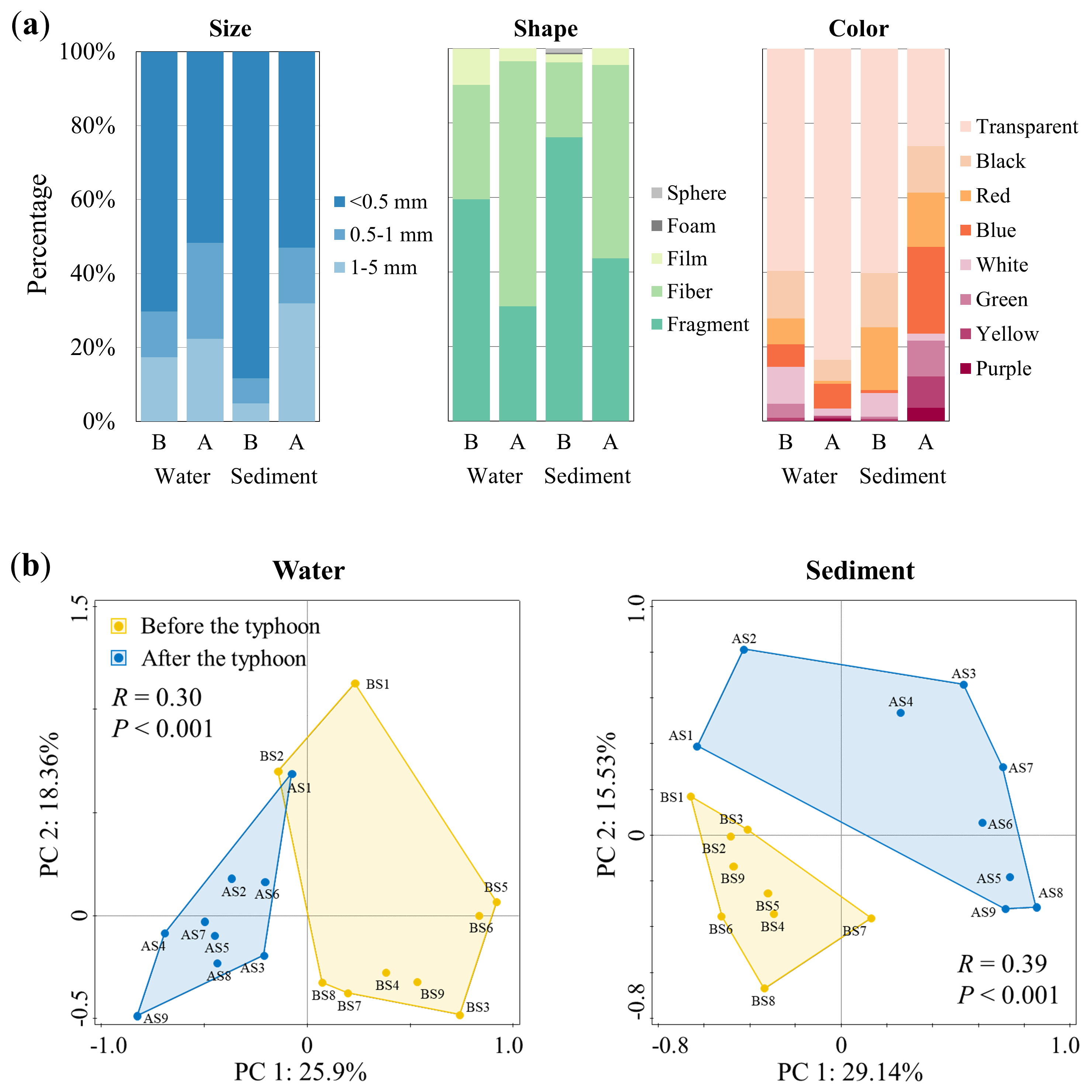
Figure 2. The microplastic characteristics before and after the typhoon (B: before the typhoon; A: after the typhoon). (a) Distribution of size, color, and shape of microplastics in surface water and sediment. (b) PCoA biplot shows the differences in microplastic characteristics before and after the typhoon for water and sediment samples.
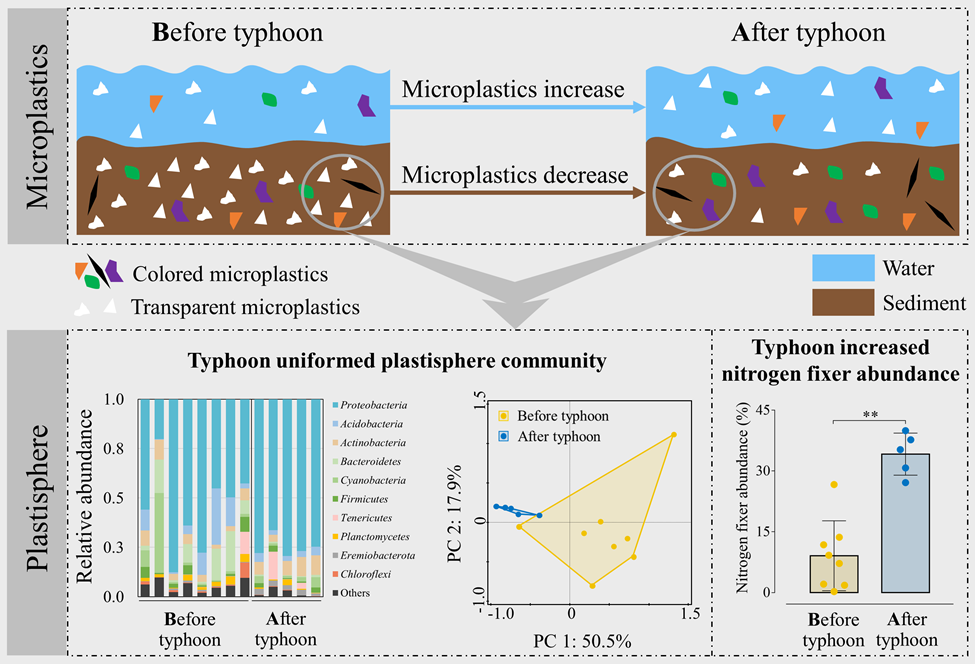
The study found a significant typhoon-induced increase in microplastic abundance in surface water, whereas an opposite trend was observed in sediment. Despite the evident transportation of microplastics from sediment to surface water by agitation, a possible microplastics influx was introduced by typhoons, as evidenced by the prominent attribution of unknown force in source tracking analysis.
Additionally, typhoons have adeptly uniformed the plastisphere community in the sediment along the 190km coastal line overnight. A significant increase of nitrogen fixer, Bradyrhizobiaceae, was observed ubiquitously after a typhoon, which might alter the nitrogen cycling and increase the eutrophic condition of the coastal ecological system. Together, this study expanded the knowledge about the impact of a typhoon-induced influx of microplastics on coastal biogeochemical cycling.
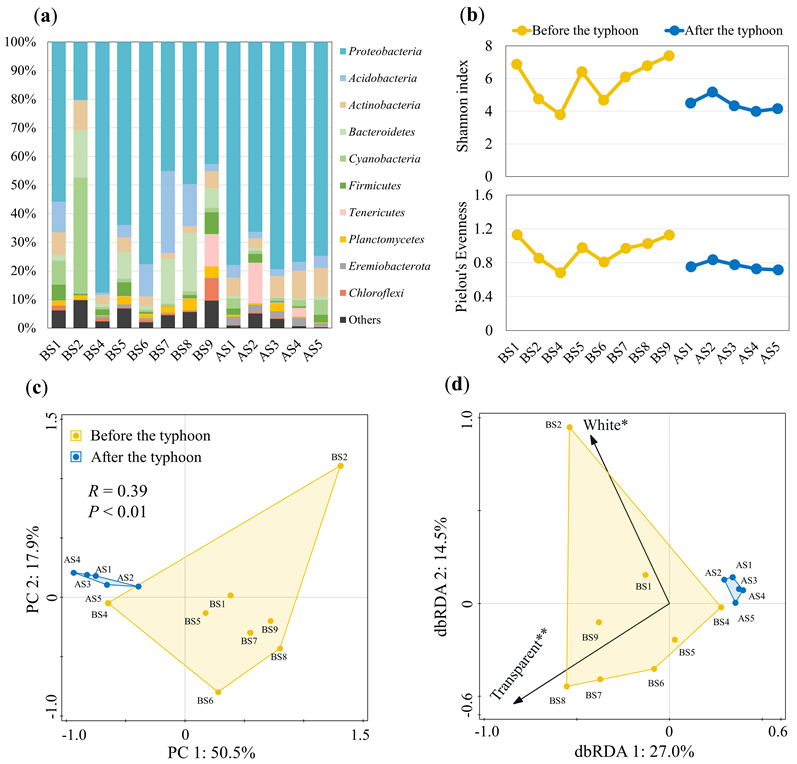
Figure 3. Bacterial community diversity of plastisphere and their shaping factors (B: before the typhoon; A: after the typhoon). (a) Bacterial community composition of plastisphere displayed at the phylum level. (b) Alpha diversity profiles of plastisphere community. Shannon and Pielou’s Evenness indices comprehensively denote the richness and homogeneity of the bacterial community. (c) Principal coordinate analysis of the plastisphere communities. (d) Bray–Curtis db-RDA plots displaying the relationships between plastisphere communities and microplastic characteristics.
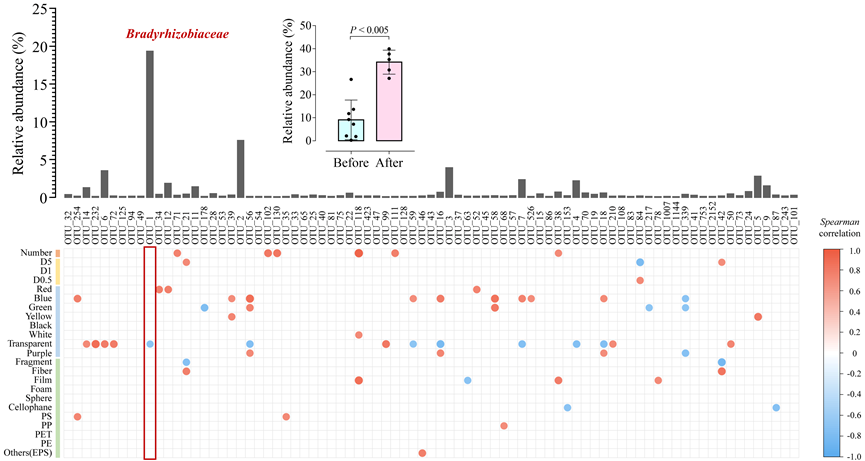
Figure 4. Spearman correlation between the relative abundance of each OTU and microplastic characteristics. OTU_1 was the most abundant taxon and affiliated with Bradyrhizobiaceae. The bar plot shows differences in the relative abundance of OTU_1 between before and after the typhoon.
Liming Chen, a postdoctoral fellow, and Jiangpeng Li, a Ph.D. student, are the co-first authors of this paper. Associate Professor Yuanyuan Tang and Assistant Professor Yu Xia from the School of Environmental Science and Engineering at SUSTech are the co-corresponding authors.
The study was supported by the National Natural Science Foundation of China (NSFC), Natural Science Foundation of Guangdong Province, State Environmental Protection Key Laboratory of Integrated Surface Water-Groundwater Pollution Control, and the Center for Computational Science and Engineering at SUSTech.
Paper link:
https://doi.org/10.1016/j.watres.2021.117580
Additional contact information:
Associate Professor Yuanyuan Tang: tangyy@sustech.edu.cn
Assistant Professor Yu Xia: xiay@sustech.edu.cn
2026-03-10
2026-09-08
A delegation of 13 students from Southern University of Science and Technology (SUSTech), Zhejiang University and the University of Science and Technology of China (USTC), accompanied by four SUSTech faculty members including including two affiliated with the State Key Laboratory of Soil Pollution Control and Safety, concluded a 12-day summer school at Flinders University in August, 2026, hosted by the University’s National Centre for Groundwater Research and Training (NCGRT).Throughout the program, the students participated in a wide range of educational activities covering water resources, environmental health, groundwater modeling, managed aquifer recharge, salinity management, mining sites management, virtual reality hydrology, and nature-based solutions for surface water, groundwater and soil pollution.A highlight of the visit was a series of field trips showcasing South Australia’s unique natural environments. These included an overnight excursion to a global showcase of integrated surface and groundwater management exemplified by the Murray-Darling Basin. Visits to the St Kilda Mangroves highlighted ecohydrological approaches to coastal mangrove conservation. While Hallett Cove featured the most famous glacial striation on pre-Cambrian rocks. Happy Valley Reservoir, Oaklands Wetland, and Port Willunga Beach, with their wildlife, water management and well-exposed sedimentary rock formations, left strong impressions on our students. Students also attended research seminars and explored Flinders University’s teaching and research facilities.This summer school provided an excellent opportunity for students to engage with Flinders University staff, students, and researchers, experience Australian approaches to soil and groundwater pollution control and safety research, and strengthen the institutional ties between SUSTech and Flinders University, while fostering international connections and cross-cultural learning. The visit was made possible through a combination of support provided by SUSTech and the Fundamental and Interdisciplinary Disciplines Breakthrough Plan of the Ministry of Education of China(JYB2025XDXM909).During the visit, Chair Professor Yan ZHENG from SUSTech delivered a research seminar on arsenic detection in the developed and developing world. Flinders University noted that its academic community was privileged to learn from her expertise.SUSTech expresses its gratitude for the incredible partnership with Flinders University at the conclusion of the program.
2026-04-22
On April 22, the Frontiers Planet Prize announced its list of 25 National Champions for 2026. Hong WANG, a 2025 graduate of the School of Environmental Science and Engineering at the Southern Universi
2026-04-20
On the morning of April 17, 2026, a delegation from Flinders University (Australia), led by Professor Colin Stirling, President of Flinders University, visited the Southern University of Science and T
2026-04-08
Hydrological models are foundational tools for water resource management, agricultural planning, flood and drought mitigation, and ecosystem protection. A long-standing challenge in hydrology is devel
 |