

© 2026 All Rights Reserved. 粤ICP备14051456号
2021-11-29
View:6
The advent of big data era brings brand-new opportunities and challenges to water resources research. Data crowdsourcing is an emerging approach that supports data acquisition from individual citizens, which opens new doors for big data collection and application in water science.
In hydrology monitoring, data crowdsourcing has become a research hotspot in recent years. However, little attention has been paid to hydro data crowdsourcing features and their implications for policy making.
Professor Yi Zheng’s group from the School of Environmental Science and Engineering at the Southern University of Science and Technology (SUSTech) recently published two papers in Water Resources Research, a top academic journal in the field of hydrology and water resources.
The two papers solved one challenge in water science apiece; one is about artificial intelligence (AI) application in the context of hydrological big data, while the other focuses on a long-standing puzzle in water resources management.
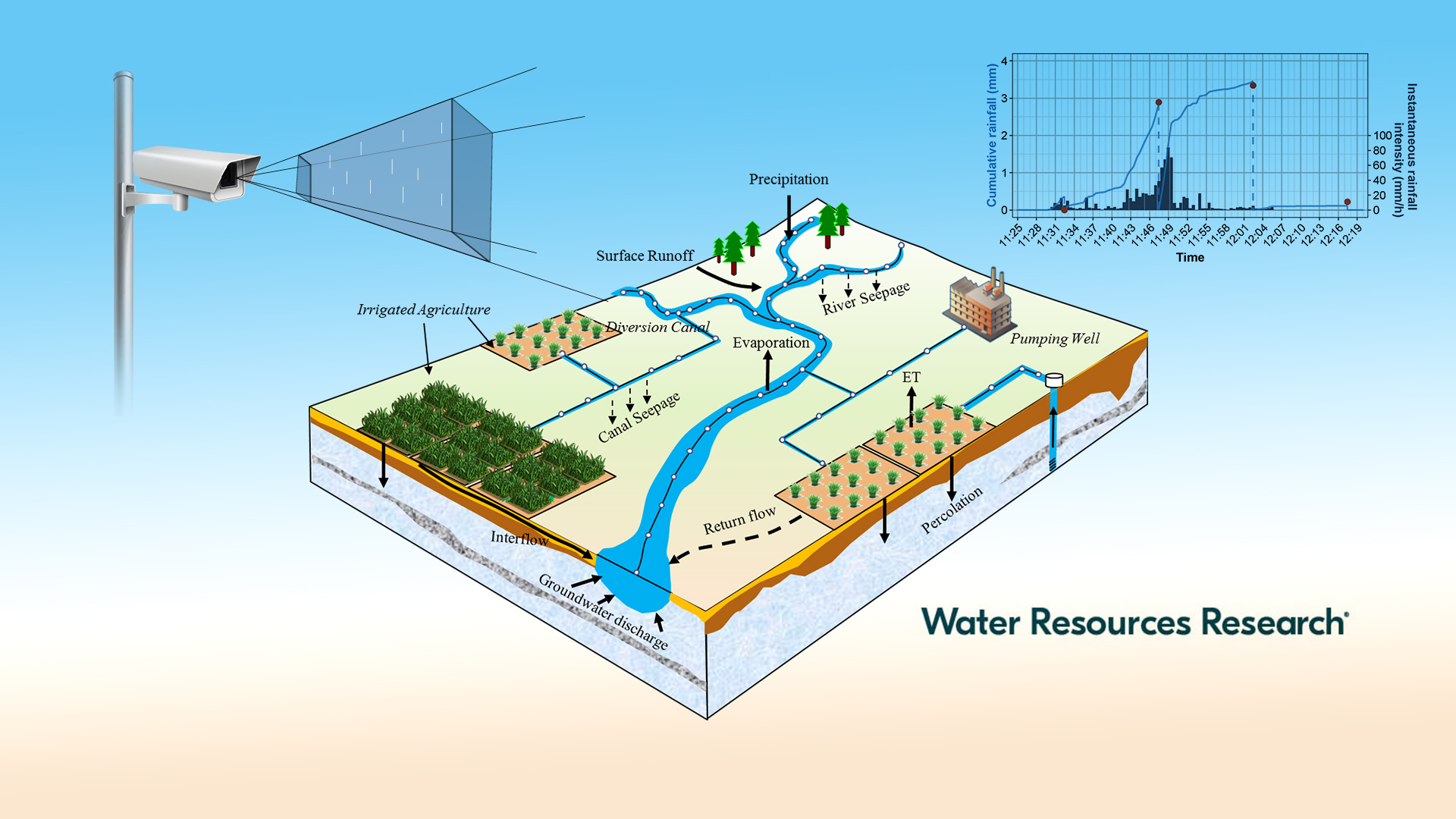
In the first paper, entitled “Automatic Quality Control of Crowdsourced Rainfall Data with Multiple Noises: A Machine Learning Approach,” Prof. Zheng’s group proposed a machine learning approach for automatic crowdsourced data quality control (CSQC) using both supervised and unsupervised algorithms.
CSQC can detect and remove noisy data inputs in spatially and temporally discrete crowdsourced observations from both fixed-point sensors (e.g., surveillance cameras) and moving sensors (e.g., moving cars/pedestrians), significantly reducing the overall rainfall estimate errors. In addition, supervised multilayer perception-based CSCC shows surprisingly good transferability. It also has great performance in reducing errors when directly applied (without retraining) to Chicago and Miami, where climate conditions are significantly different from where the model was trained (San Diego).
This study provides important technical supports for the collection and application of rainfall crowdsourcing data. It brings scientific implications in promoting the applications of big data, artificial intelligence, and the internet of things in smart city construction.

Figure 1. Quality control of crowdsourced rainfall data using machine learning
Geng Niu, a Ph.D. candidate under the joint Ph.D. program of SUSTech and Peking University (PKU), is the first author of this paper. Prof. Yi Zheng and Dr. Yang Pan from the University of Illinois Urbana-Champaign are the co-corresponding authors.
The work was financially supported by the National Natural Science Foundation of China (NSFC), Shenzhen Science and Technology Innovation Commission, and the China Scholarship Council (CSC).
Providing a new perspective to IE paradox
The paradox of irrigation efficiency (IE), that is, higher efficiency rarely reduces, even increases irrigation water consumption, has long been recognized since the last century. However, issues surrounding the existence of the IE paradox and underlying mechanisms are of continuing debate. In addition to geographic differences in the natural environment and social economy, another important reason leading to the controversy is the lack of consensus regarding IE definition and the absence of scientifically rigorous assessment of IE.
In the second paper, entitled “Improving the Scientific Understanding of the Paradox of Irrigation Efficiency: An Integrated Modeling Approach to Assessing Basin-Scale Irrigation Efficiency,” Prof. Zheng’s group developed a new basin-scale IE index to explicitly account for the role of return flow and groundwater’s direct contributions to crop evapotranspiration.
Based on multiscale water balance, they proposed a new method for quantifying basin-scale IE via integrated surface water-groundwater modeling. The Zhangye Basin (Gansu Province, China), sitting in the center of the Hexi Corridor, was chosen as the study area, where irrigated agriculture and ecosystems compete against each other for limited water resources.
With the proposed index and method, Prof. Zheng’s group unraveled the spatiotemporal variations of IE and the governing mechanisms over this typical inland arid basin, and identified opportunities to enhance IE and save water at the basin scale. This study provides a methodological foundation and a brand-new perspective for overcoming the misunderstanding of the IE paradox.
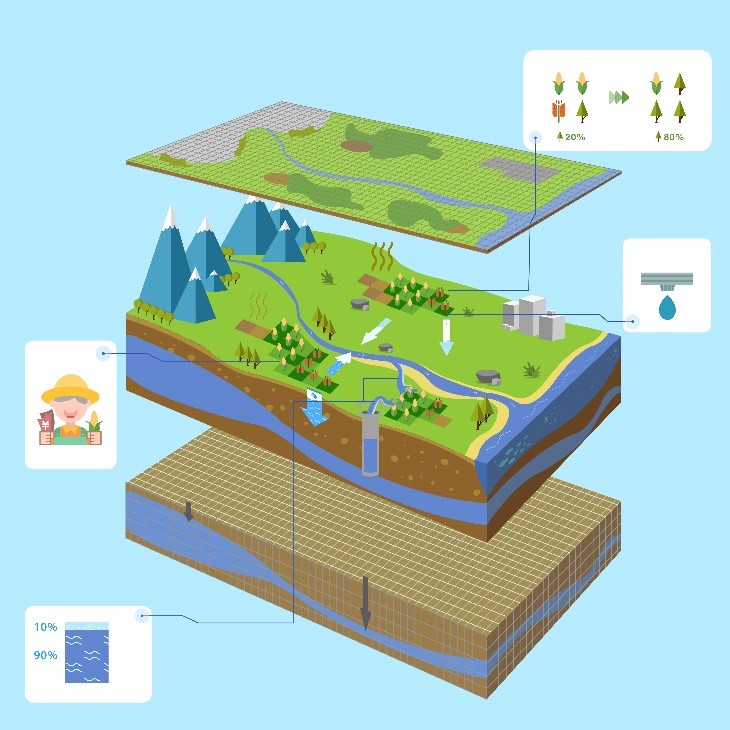
Figure 2. Calculating basin-scale irrigation efficiency via integrated surface water-groundwater modeling
Rui Xiong, a Ph.D. candidate under the joint Ph.D. program of SUSTech and Hong Kong University of Science and Technology (HKUST), is the first author of this paper. Professor Yi Zheng is the corresponding author.
The work was financially supported by the NSFC, the Strategic Priority Research Program of the Chinese Academy of Sciences, and the State Environmental Protection Key Laboratory of Integrated Surface Water-Groundwater Pollution Control.
Paper links (In order of appearance above):
Water Resources Research: https://doi.org/10.1029/2020WR029121
Water Resources Research: https://doi.org/10.1029/2020WR029397
2026-03-10
2026-09-08
A delegation of 13 students from Southern University of Science and Technology (SUSTech), Zhejiang University and the University of Science and Technology of China (USTC), accompanied by four SUSTech faculty members including including two affiliated with the State Key Laboratory of Soil Pollution Control and Safety, concluded a 12-day summer school at Flinders University in August, 2026, hosted by the University’s National Centre for Groundwater Research and Training (NCGRT).Throughout the program, the students participated in a wide range of educational activities covering water resources, environmental health, groundwater modeling, managed aquifer recharge, salinity management, mining sites management, virtual reality hydrology, and nature-based solutions for surface water, groundwater and soil pollution.A highlight of the visit was a series of field trips showcasing South Australia’s unique natural environments. These included an overnight excursion to a global showcase of integrated surface and groundwater management exemplified by the Murray-Darling Basin. Visits to the St Kilda Mangroves highlighted ecohydrological approaches to coastal mangrove conservation. While Hallett Cove featured the most famous glacial striation on pre-Cambrian rocks. Happy Valley Reservoir, Oaklands Wetland, and Port Willunga Beach, with their wildlife, water management and well-exposed sedimentary rock formations, left strong impressions on our students. Students also attended research seminars and explored Flinders University’s teaching and research facilities.This summer school provided an excellent opportunity for students to engage with Flinders University staff, students, and researchers, experience Australian approaches to soil and groundwater pollution control and safety research, and strengthen the institutional ties between SUSTech and Flinders University, while fostering international connections and cross-cultural learning. The visit was made possible through a combination of support provided by SUSTech and the Fundamental and Interdisciplinary Disciplines Breakthrough Plan of the Ministry of Education of China(JYB2025XDXM909).During the visit, Chair Professor Yan ZHENG from SUSTech delivered a research seminar on arsenic detection in the developed and developing world. Flinders University noted that its academic community was privileged to learn from her expertise.SUSTech expresses its gratitude for the incredible partnership with Flinders University at the conclusion of the program.
2026-04-22
On April 22, the Frontiers Planet Prize announced its list of 25 National Champions for 2026. Hong WANG, a 2025 graduate of the School of Environmental Science and Engineering at the Southern Universi
2026-04-20
On the morning of April 17, 2026, a delegation from Flinders University (Australia), led by Professor Colin Stirling, President of Flinders University, visited the Southern University of Science and T
2026-04-08
Hydrological models are foundational tools for water resource management, agricultural planning, flood and drought mitigation, and ecosystem protection. A long-standing challenge in hydrology is devel
 |