

© 2026 All Rights Reserved. 粤ICP备14051456号
2022-03-18
View:12
Recent rapid urbanization worldwide resulted in increasing urban residents. Short-term (sub-daily) precipitation extremes are expected to be more frequent and intense than in the past as the global climate continues to warm. Many urban areas worldwide have witnessed the consequences of extreme precipitation events, resulting in devastating waterlogging and flash flooding. China has experienced rapid urbanization since the 1980s. During this period, the country has suffered many recent severe urban flooding episodes, causing great casualties and economic losses. However, most of the work has been performed for only a few metropolitan areas. The knowledge of the effects of urbanization on precipitation at regional-to-national scales in China remains limited.
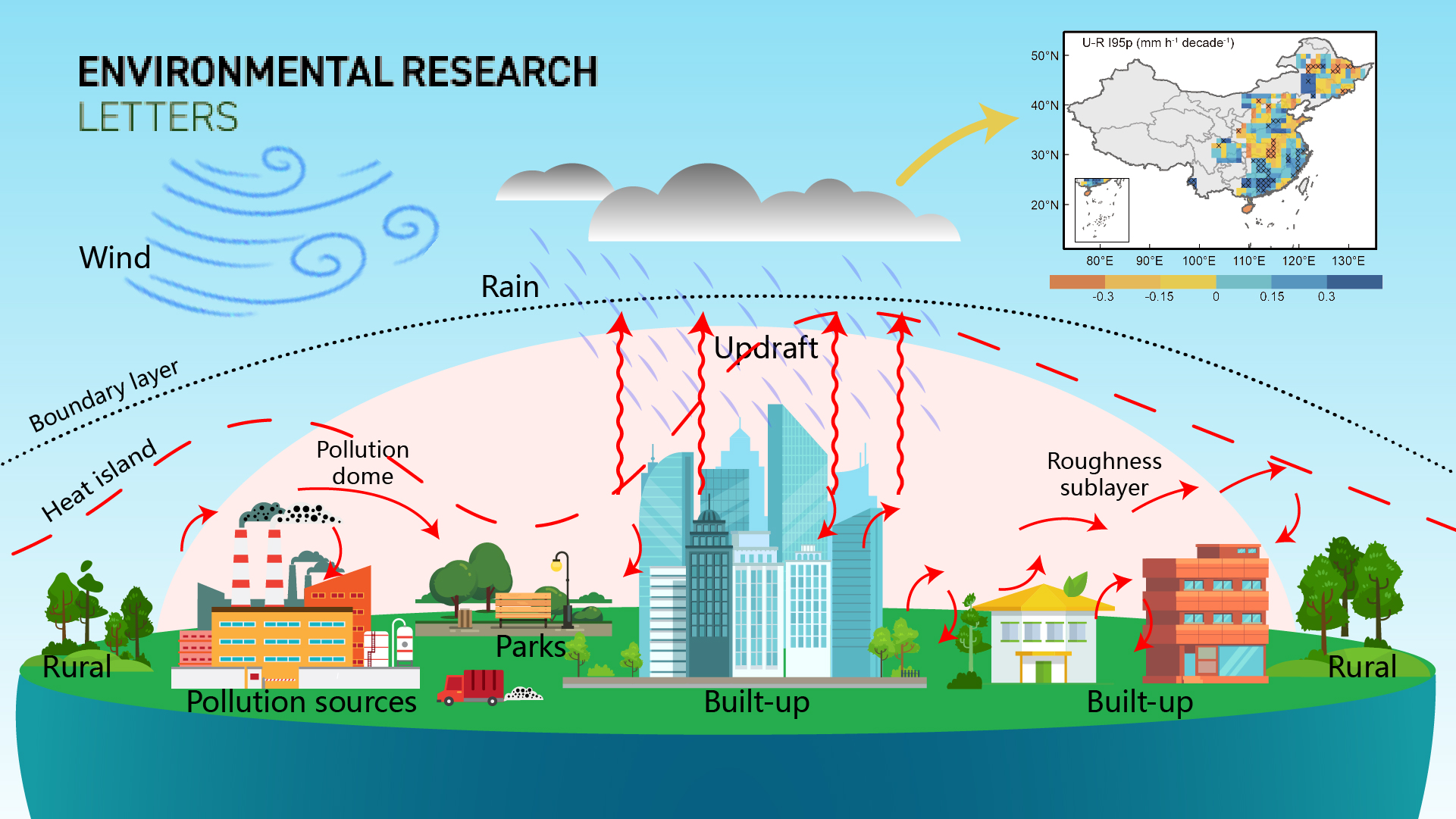
Xiaowen Huang, an undergraduate of the School of Environmental Science and Engineering at the Southern University of Science and Technology (SUSTech), was part of a research team that has recently published their results on the impact of urbanization on hourly extreme precipitation in China. The paper, entitled “Influence of urbanization on hourly extreme precipitation over China,” was published in Environmental Research Letters.
Based on hourly precipitation data from April to October from more than 2000 meteorological stations and annual urban land cover change data in China during 1985-2012, the researchers analyzed the spatiotemporal pattern of urbanization-induced variation in frequency and intensity of hourly extreme precipitation in the rainy season of 28 years by adopting dynamic urban-rural station classification method. The study found that urbanization in south China brings more extreme precipitation to urban areas than to suburbs and continually reduces extreme precipitation over urban areas in parts of the north and northeast.
Six specific regions were selected to explore further the impact of urbanization on extreme precipitation in each month of the rainy season. The diurnal cycle of precipitation difference between urban and rural areas was analyzed by selecting the months with a larger urban-rural difference in each region. Urbanization enhances extreme precipitation mainly in the main local part of the rainy season and increases hourly extreme precipitation at peak times in diurnal cycles.
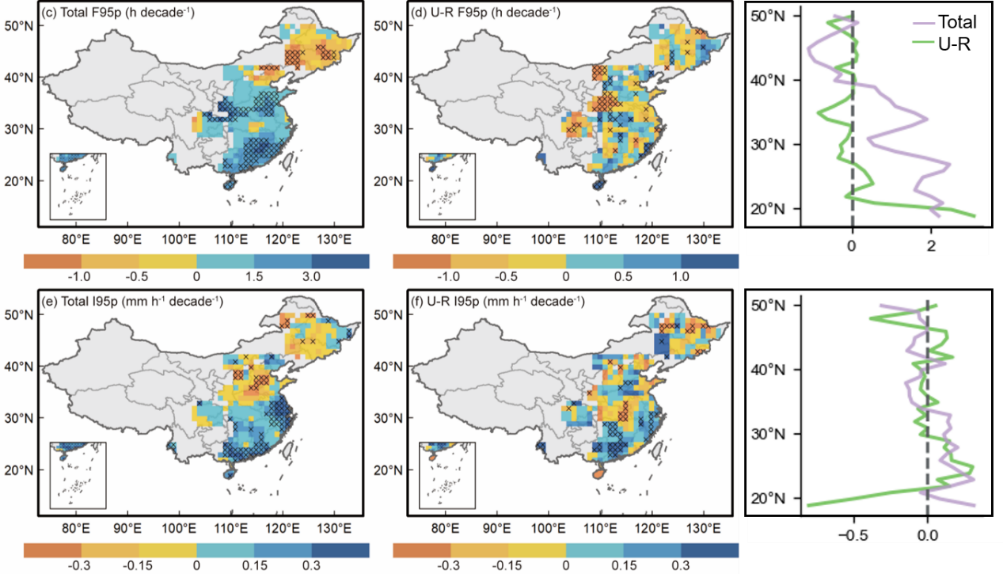
Figure 1. Spatial distribution of linear trend of extreme precipitation frequency and intensity over China for all-station anomalies and urban-rural differences, 1985-2012, along with their zonal means
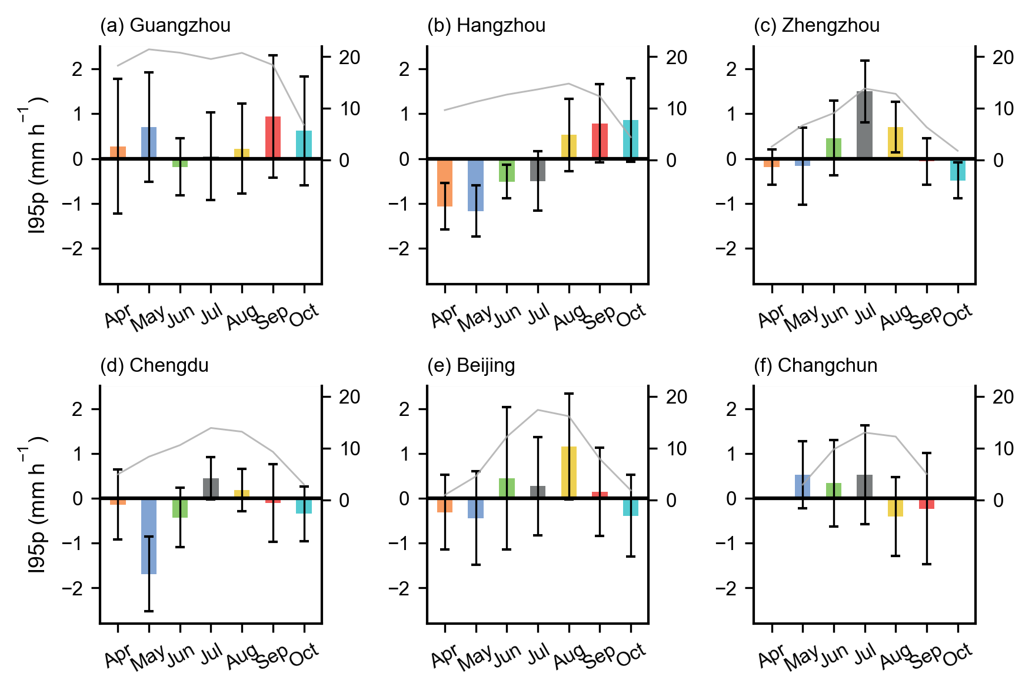
Figure 2. Seasonality of the urban-rural difference of extreme precipitation intensity (unit: mm h-1) in the six regions, 1985-2012
The study reveals the impact of urbanization on the spatiotemporal pattern of extreme precipitation over China, including smaller size cities separated from large urban agglomerations. These patterns warrant attention when assessing the risk of increased waterlogging and flash flooding, and provide insights into future hazard mitigation in urban areas.
Xiaowen Huang from SUSTech is the first author of this paper. Associate Professor Zhenzhong Zeng and Research Assistant Professor Dashan Wang are the co-corresponding authors.
This study was supported by the National Natural Science Foundation of China (NSFC), the China Postdoctoral Science Foundation, and SUSTech.
Paper link: https://iopscience.iop.org/article/10.1088/1748-9326/ac59a6
2026-03-10
2026-09-08
A delegation of 13 students from Southern University of Science and Technology (SUSTech), Zhejiang University and the University of Science and Technology of China (USTC), accompanied by four SUSTech faculty members including including two affiliated with the State Key Laboratory of Soil Pollution Control and Safety, concluded a 12-day summer school at Flinders University in August, 2026, hosted by the University’s National Centre for Groundwater Research and Training (NCGRT).Throughout the program, the students participated in a wide range of educational activities covering water resources, environmental health, groundwater modeling, managed aquifer recharge, salinity management, mining sites management, virtual reality hydrology, and nature-based solutions for surface water, groundwater and soil pollution.A highlight of the visit was a series of field trips showcasing South Australia’s unique natural environments. These included an overnight excursion to a global showcase of integrated surface and groundwater management exemplified by the Murray-Darling Basin. Visits to the St Kilda Mangroves highlighted ecohydrological approaches to coastal mangrove conservation. While Hallett Cove featured the most famous glacial striation on pre-Cambrian rocks. Happy Valley Reservoir, Oaklands Wetland, and Port Willunga Beach, with their wildlife, water management and well-exposed sedimentary rock formations, left strong impressions on our students. Students also attended research seminars and explored Flinders University’s teaching and research facilities.This summer school provided an excellent opportunity for students to engage with Flinders University staff, students, and researchers, experience Australian approaches to soil and groundwater pollution control and safety research, and strengthen the institutional ties between SUSTech and Flinders University, while fostering international connections and cross-cultural learning. The visit was made possible through a combination of support provided by SUSTech and the Fundamental and Interdisciplinary Disciplines Breakthrough Plan of the Ministry of Education of China(JYB2025XDXM909).During the visit, Chair Professor Yan ZHENG from SUSTech delivered a research seminar on arsenic detection in the developed and developing world. Flinders University noted that its academic community was privileged to learn from her expertise.SUSTech expresses its gratitude for the incredible partnership with Flinders University at the conclusion of the program.
2026-04-22
On April 22, the Frontiers Planet Prize announced its list of 25 National Champions for 2026. Hong WANG, a 2025 graduate of the School of Environmental Science and Engineering at the Southern Universi
2026-04-20
On the morning of April 17, 2026, a delegation from Flinders University (Australia), led by Professor Colin Stirling, President of Flinders University, visited the Southern University of Science and T
2026-04-08
Hydrological models are foundational tools for water resource management, agricultural planning, flood and drought mitigation, and ecosystem protection. A long-standing challenge in hydrology is devel
 |