

© 2026 All Rights Reserved. 粤ICP备14051456号
2022-09-19
View:9
The sixth assessment report of the IPCC indicates low-to-high confidence in trends of extreme rainfall with regional inconsistency in the tropics, where a key phenomenon causing intra-seasonal variations in weather is the Madden–Julian Oscillation (MJO). MJO is the several-thousand-km envelope of clouds, winds, and rainfall that moves eastwards along the equator with a 20–90 day timescale during the boreal winter season, triggering extreme rainfall over tropical Asia and northern Australia.
Many studies have made projections on changes in MJO activity in a warming climate via Earth System Models (ESMs). Still, it remains unclear how changes in MJO-induced extreme rainfall may influence societal exposure in response to future warming and climate mitigation attempts. Such efforts rely on accurate simulation of MJO processes in ESMs. However, most CMIP5 models largely underestimate MJO amplitude and fail to reproduce a coherent eastward propagation of MJO. Recently, some CMIP6 ESMs have demonstrated substantial improvements in simulating the structure of MJO. These model advances create an opportunity to address the dynamics of MJO-related extreme rainfall and its potential socio-economic consequences in the coming decades.

Associate Professor Zhenzhong Zeng’s team from the School of Environmental Science and Engineering at the Southern University of Science and Technology (SUSTech) has recently published their findings where they evaluate the model outputs from the Coupled Model Intercomparison Project Phase 6 to project the changes of MJO-induced extreme rainfall and the associated societal exposure in response to future warming and climate mitigation attempts at the end of the 21st century.
Their research, entitled “Madden-Julian Oscillation-induced extreme rainfalls constrained by global warming mitigation,” was published in npj Climate and Atmospheric Science, a journal by Nature covering the relevant physical, chemical, and biological components of atmospheric and climate science.
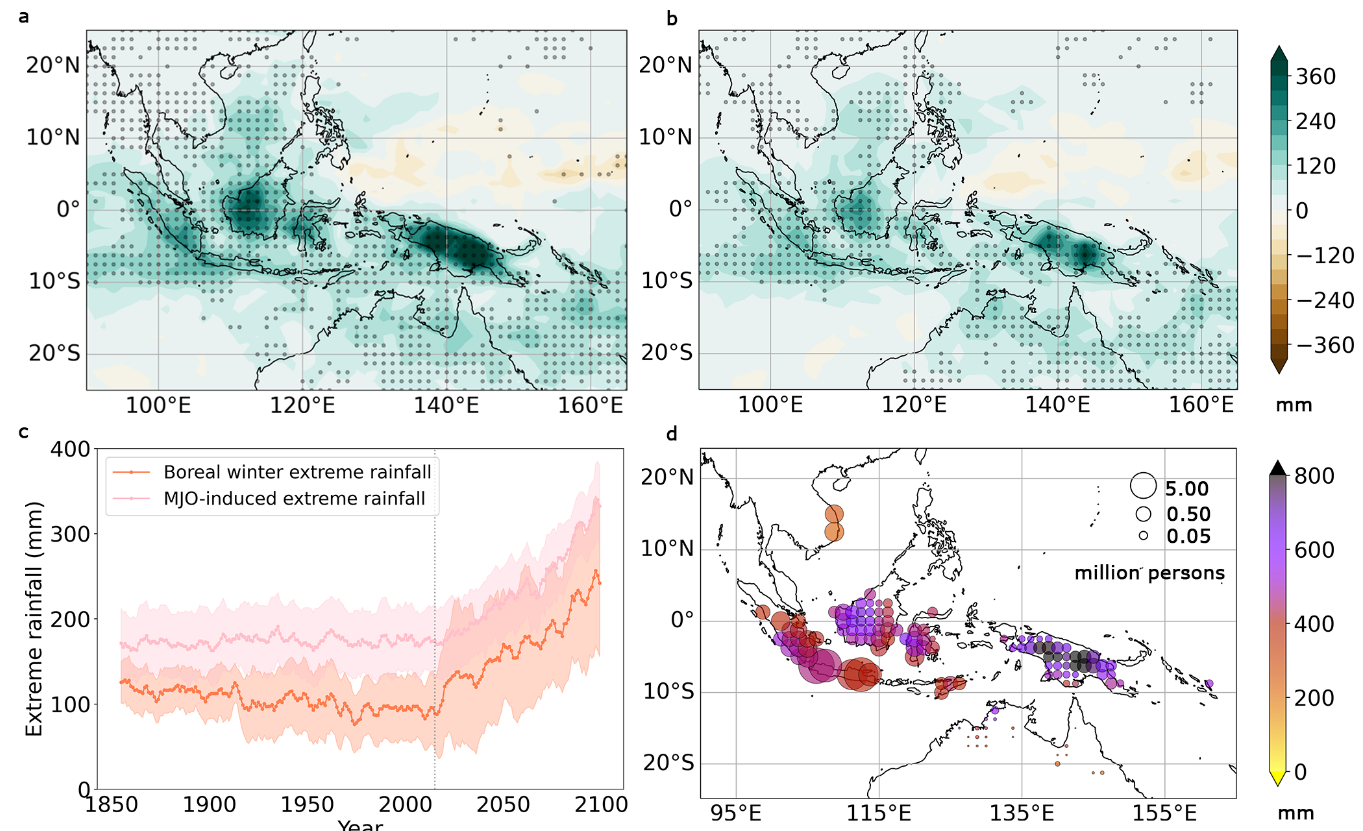
Figure 1. Spatiotemporal changes of multi-model mean boreal winter extreme rainfall under the SSP5-8.5 scenario. Spatial distribution of the changes in boreal winter extreme rainfall amount (a) and MJO-induced extreme rainfall amount (b) between the future period (2079–2099) and the present period (2015–2035) under the SSP5-8.5 scenario over the study area. Stippling denotes where the multi-model mean changes exceed the inter-model variance. c) Temporal series of the boreal winter extreme rainfall and MJO-induced extreme rainfall over the land areas within 25°S–20°N, 95°E–155°E during 1855-2099. Values are smoothed through the 5-year running mean. Shadings refer to half of the inter-model spread. d) Exposure map of population to the projected increases of future MJO-induced extreme rainfall. The future MJOinduced extreme rainfall is the simulated increments between the future (2079–2099) and present (2015–2035) periods added up to the historical period (1994–2014). The size of the circles represents the amount of exposed population, while the color shows the MJO-induced extreme rainfall amount.
The researchers detect a nearly 60% increase in extreme rainfall over tropical Asia and Australia by the end of the 21st century under the fossil-fueled warming scenario (SSP5-8.5); 84% of this change is associated with MJO-induced extreme rainfall. The regions that are most likely to be affected include Malaysia, Indonesia, and northern Australia, where 96.68 million people and 9.72 million km2 of urban areas are exposed to potential danger stemming from extreme rainfall. More than 95% (99%) of the population (urban) exposure can be potentially avoided under the “middle of the road” development (SSP2-4.5) scenario, whereby CO2 emissions hover around current levels before starting to fall mid-century.
Shijing Liang, a master’s student in the School of Environmental Science and Engineering at SUSTech, is the first author of this paper. Research Asst. Prof.Dashan Wang and Assoc.Prof.Zhenzhong Zeng from SUSTech are the corresponding authors. Cooperating members include Prof. Alan D. Ziegler of MaeJo University (MJU) and Prof. Laurent Z. X. Li of Laboratoire de Météorologie Dynamique (LMD).
This study was supported by the National Natural Science Foundation of China (NSFC), the Start-Up Fund provided by SUSTech, and the China Postdoctoral Science Foundation.
Paper link: https://www.nature.com/articles/s41612-022-00291-1
2026-03-10
2026-09-08
A delegation of 13 students from Southern University of Science and Technology (SUSTech), Zhejiang University and the University of Science and Technology of China (USTC), accompanied by four SUSTech faculty members including including two affiliated with the State Key Laboratory of Soil Pollution Control and Safety, concluded a 12-day summer school at Flinders University in August, 2026, hosted by the University’s National Centre for Groundwater Research and Training (NCGRT).Throughout the program, the students participated in a wide range of educational activities covering water resources, environmental health, groundwater modeling, managed aquifer recharge, salinity management, mining sites management, virtual reality hydrology, and nature-based solutions for surface water, groundwater and soil pollution.A highlight of the visit was a series of field trips showcasing South Australia’s unique natural environments. These included an overnight excursion to a global showcase of integrated surface and groundwater management exemplified by the Murray-Darling Basin. Visits to the St Kilda Mangroves highlighted ecohydrological approaches to coastal mangrove conservation. While Hallett Cove featured the most famous glacial striation on pre-Cambrian rocks. Happy Valley Reservoir, Oaklands Wetland, and Port Willunga Beach, with their wildlife, water management and well-exposed sedimentary rock formations, left strong impressions on our students. Students also attended research seminars and explored Flinders University’s teaching and research facilities.This summer school provided an excellent opportunity for students to engage with Flinders University staff, students, and researchers, experience Australian approaches to soil and groundwater pollution control and safety research, and strengthen the institutional ties between SUSTech and Flinders University, while fostering international connections and cross-cultural learning. The visit was made possible through a combination of support provided by SUSTech and the Fundamental and Interdisciplinary Disciplines Breakthrough Plan of the Ministry of Education of China(JYB2025XDXM909).During the visit, Chair Professor Yan ZHENG from SUSTech delivered a research seminar on arsenic detection in the developed and developing world. Flinders University noted that its academic community was privileged to learn from her expertise.SUSTech expresses its gratitude for the incredible partnership with Flinders University at the conclusion of the program.
2026-04-22
On April 22, the Frontiers Planet Prize announced its list of 25 National Champions for 2026. Hong WANG, a 2025 graduate of the School of Environmental Science and Engineering at the Southern Universi
2026-04-20
On the morning of April 17, 2026, a delegation from Flinders University (Australia), led by Professor Colin Stirling, President of Flinders University, visited the Southern University of Science and T
2026-04-08
Hydrological models are foundational tools for water resource management, agricultural planning, flood and drought mitigation, and ecosystem protection. A long-standing challenge in hydrology is devel
 |