

© 2026 All Rights Reserved. 粤ICP备14051456号
2023-03-30
View:20
Previously, forest loss primarily occurred in lowlands where forests are easy to access, and mountain areas had limited forest loss due to their rugged location. However, since the turn of the 21st century, mountain forests have been increasingly exploited as lowland areas become depleted or subject to protection.
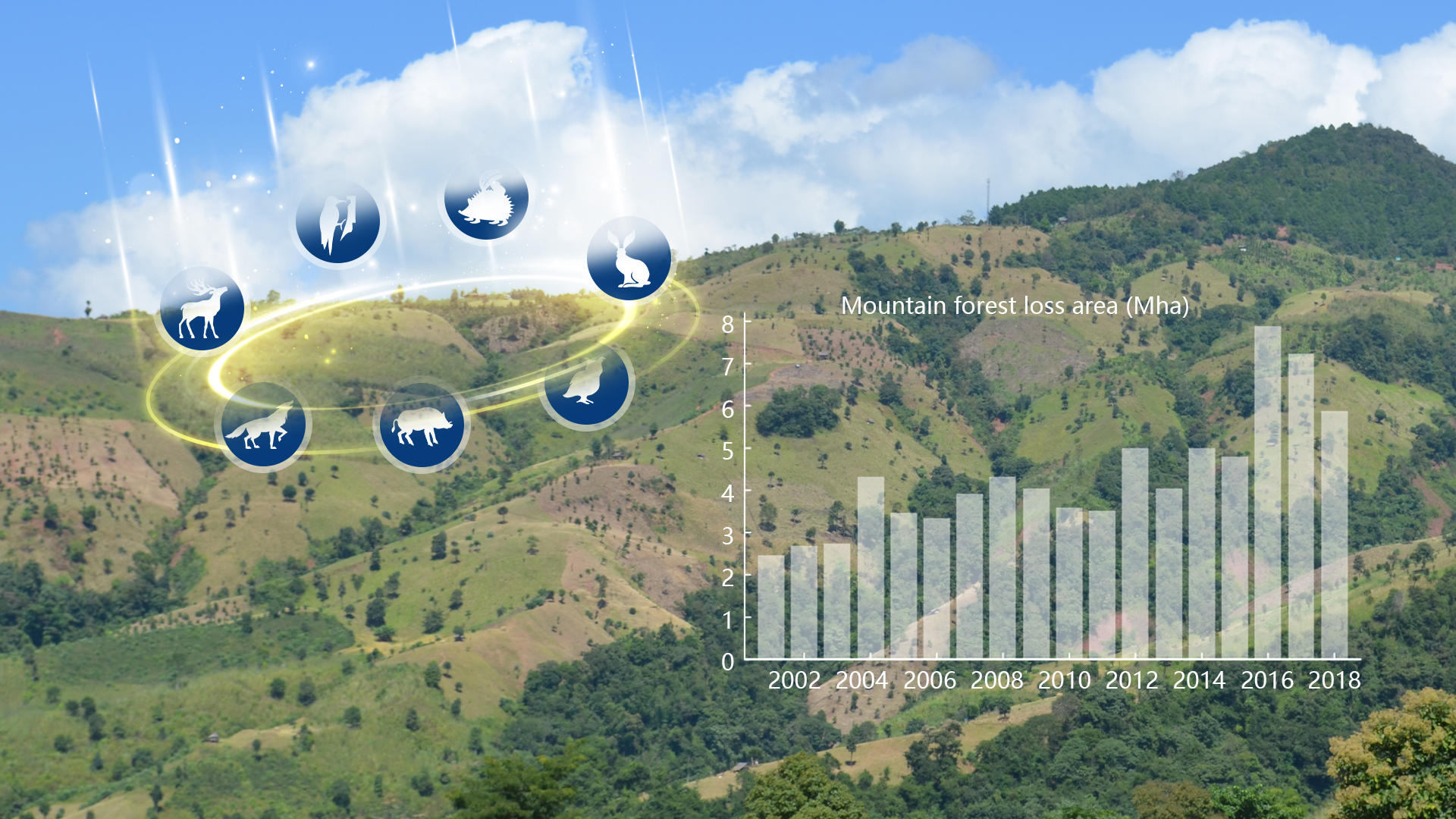
Associate Professor Zhenzhong Zeng’s research team from the School of Environmental Science and Engineering at the Southern University of Science and Technology (SUSTech) has recently reported that forest loss across mountain regions is accelerating during the 21st century, with recent losses being 2.7-fold greater than those at the beginning of the century. Much of the loss occurred in tropical biodiversity hotspots, putting increasing pressure on threatened species.
Their research work, entitled “Accelerating global mountain forest loss threatens biodiversity hotspots,” has been published in One Earth, a journal that publishes significant original research that seeks to understand and address today’s environmental grand challenges.
The work uncovered global mountain forest loss patterns and drivers using multiple high-resolution satellite products of forest change and topography. “Globally, we have lost 78 million hectares (7.1%) of mountain forest since 2000—an area larger than the size of Qinghai Province,” the authors said. Logging was the biggest driver of mountain forest loss overall (42%), followed by wildfires (29%), shifting cultivation (15%), and commodity agriculture (10%), though the importance of these different factors varied from region to region.
The research team further found that tropical mountain forests experienced the most loss—42% of the global total—and the fastest acceleration rate. Worse, much of the loss overlaps with tropical biodiversity hotspots, which were dominated by various types of agriculture expansion. The study pointed out that efforts to curb the acceleration of mountain forest loss require regionally appropriate interventions. “In areas where shifting cultivation is a strong driver, efforts should be made to ensure agriculture does not impact frontier forests where possible. Whereas in regions where commodity production is more prevalent, increased commitment is needed urgently to halt commodity-driven forest loss and safeguard mountain forest biodiversity.”
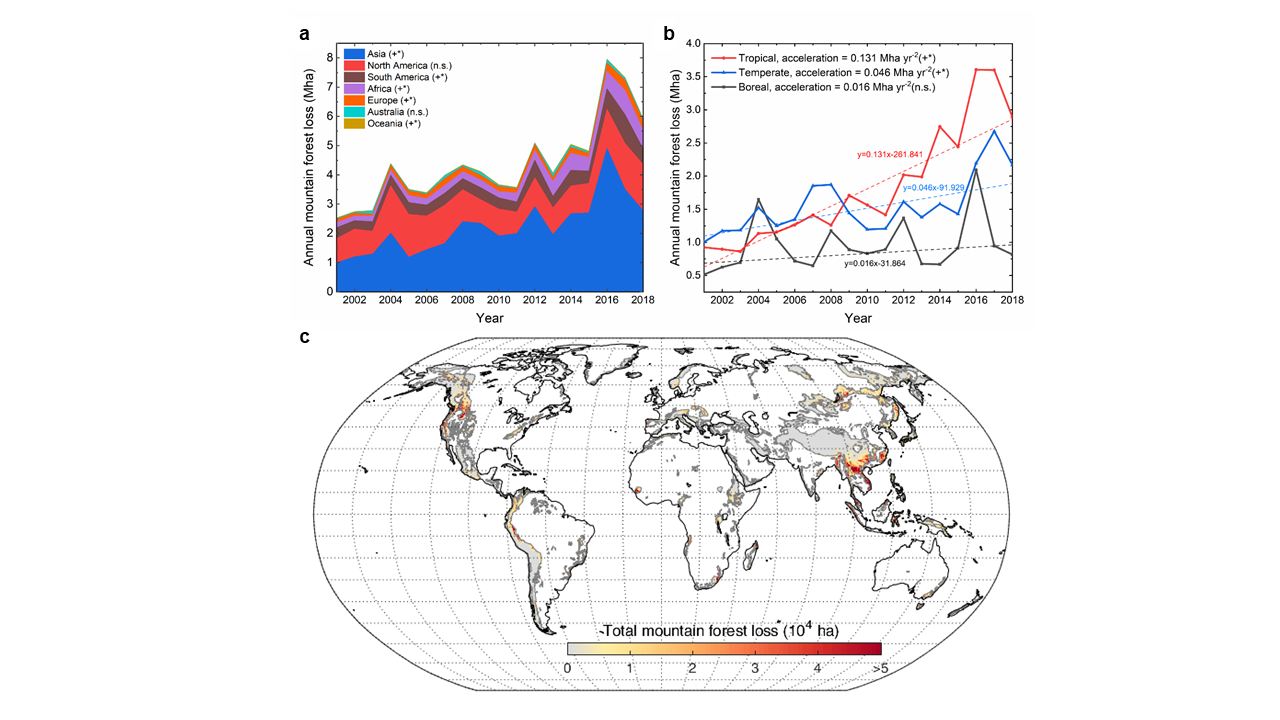
Figure 1. The pattern of mountain forest loss in the 21st century. (a) Annual mountain forest loss in different continents. A symbol (+*) after the region shows a significant positive trend in mountain forest loss at the 95% confidence interval; (n.s.) means no significant trend in mountain forest loss. (b) Annual mountain forest loss in tropical (24°S to 24°N), boreal (≥50°N), and temperate (residual) regions. (c) Spatial pattern of total mountain forest loss area in 0.5° cells.
The authors also emphasized the importance of protected areas in preventing mountain forest loss, but they caution that this might not be sufficient to preserve threatened species. For sensitive species in biodiversity hotspots, the key issue is not only to simply limit forest loss across mountain regions, but to maintain the integrity of mountain forests to guarantee enough space for species to naturally move and migrate.
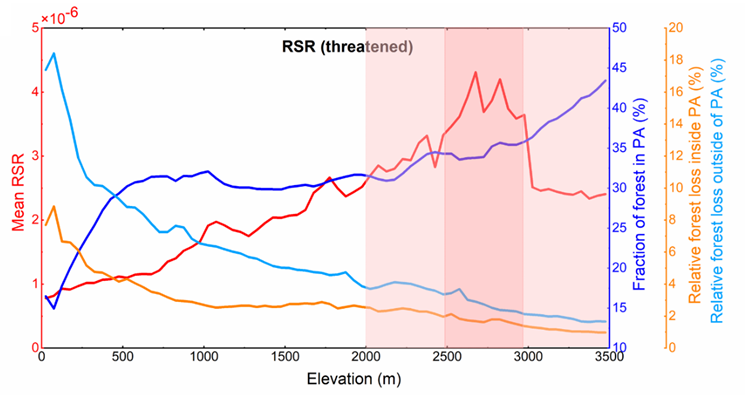
Figure 2. Elevational gradients of biodiversity value, protected area (PA) coverage, and mountain forest loss inside and outside of PAs within biodiversity hotspots. RSR (range-size rarity) is a biodiversity metric representing the endemicity.
Ph.D. student Xinyue He is the first author of this paper. Assoc. Prof. Zhenzhong Zeng is the corresponding author. SUSTech is the first correspondent of the paper.
Other researchers that contributed to the project included former Ph.D. student Yu Feng and master’s student Shijing Liang from SUSTech; Prof. Alan D. Ziegler from Mae Jo University (MJU); Dr. Paul R. Elsen from the Wildlife Conservation Society (WCS); and postdoctoral fellow Jessica C.A. Baker, Prof. Joseph Holden, and Prof. Dominick V. Spracklen from the University of Leeds.
This study was supported by the National Natural Science Foundation of China (NSFC) and SUSTech.
Paper link: https://doi.org/10.1016/j.oneear.2023.02.005
2026-03-10
2026-09-08
A delegation of 13 students from Southern University of Science and Technology (SUSTech), Zhejiang University and the University of Science and Technology of China (USTC), accompanied by four SUSTech faculty members including including two affiliated with the State Key Laboratory of Soil Pollution Control and Safety, concluded a 12-day summer school at Flinders University in August, 2026, hosted by the University’s National Centre for Groundwater Research and Training (NCGRT).Throughout the program, the students participated in a wide range of educational activities covering water resources, environmental health, groundwater modeling, managed aquifer recharge, salinity management, mining sites management, virtual reality hydrology, and nature-based solutions for surface water, groundwater and soil pollution.A highlight of the visit was a series of field trips showcasing South Australia’s unique natural environments. These included an overnight excursion to a global showcase of integrated surface and groundwater management exemplified by the Murray-Darling Basin. Visits to the St Kilda Mangroves highlighted ecohydrological approaches to coastal mangrove conservation. While Hallett Cove featured the most famous glacial striation on pre-Cambrian rocks. Happy Valley Reservoir, Oaklands Wetland, and Port Willunga Beach, with their wildlife, water management and well-exposed sedimentary rock formations, left strong impressions on our students. Students also attended research seminars and explored Flinders University’s teaching and research facilities.This summer school provided an excellent opportunity for students to engage with Flinders University staff, students, and researchers, experience Australian approaches to soil and groundwater pollution control and safety research, and strengthen the institutional ties between SUSTech and Flinders University, while fostering international connections and cross-cultural learning. The visit was made possible through a combination of support provided by SUSTech and the Fundamental and Interdisciplinary Disciplines Breakthrough Plan of the Ministry of Education of China(JYB2025XDXM909).During the visit, Chair Professor Yan ZHENG from SUSTech delivered a research seminar on arsenic detection in the developed and developing world. Flinders University noted that its academic community was privileged to learn from her expertise.SUSTech expresses its gratitude for the incredible partnership with Flinders University at the conclusion of the program.
2026-04-22
On April 22, the Frontiers Planet Prize announced its list of 25 National Champions for 2026. Hong WANG, a 2025 graduate of the School of Environmental Science and Engineering at the Southern Universi
2026-04-20
On the morning of April 17, 2026, a delegation from Flinders University (Australia), led by Professor Colin Stirling, President of Flinders University, visited the Southern University of Science and T
2026-04-08
Hydrological models are foundational tools for water resource management, agricultural planning, flood and drought mitigation, and ecosystem protection. A long-standing challenge in hydrology is devel
 |