

© 2026 All Rights Reserved. 粤ICP备14051456号
2025-11-05
View:21
Increasing extreme winds challenge offshore wind energy resilience
Extreme wind events over the world’s oceans are intensifying under climate change, posing growing risks to the durability and safety of offshore wind power installations. For instance, the land fall of Typhoon Yagi (2024) caused the collapse of six wind turbine in Hainan, China (Figure 1). As offshore wind energy expands rapidly to meet global decarbonization goals, understanding how changing wind extremes may impact turbine design and operational safety has become increasingly critical.
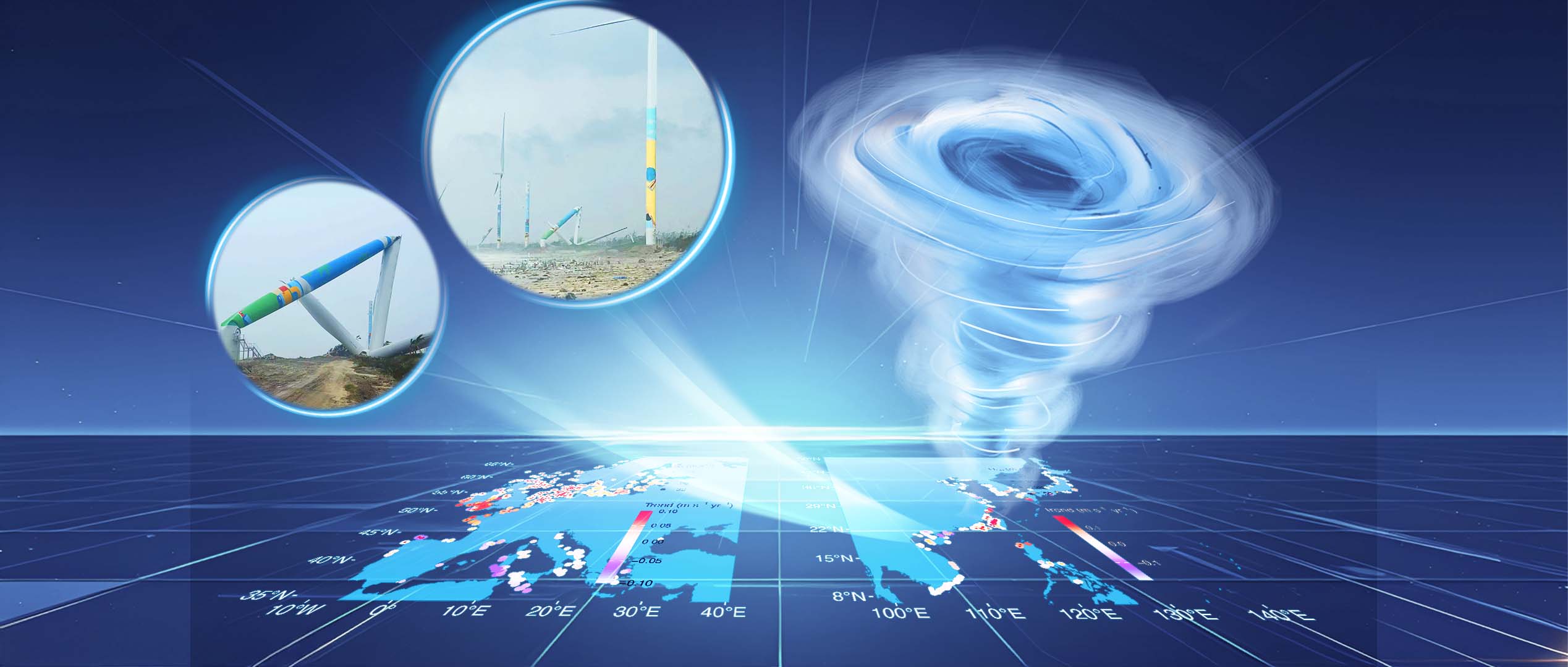
A new study led by Professor Zhenzhong Zeng’s research team from the School of Environmental Science and Engineering at the Southern University of Science and Technology (SUSTech) has revealed that the 50-year return period wind speed—a critical factor in turbine structural design—has risen significantly across oceans, with implications for both operational and planned wind farms.
The research, published in Nature Communications under the title “Increasing extreme winds challenge offshore wind energy resilience,” analyzed hourly wind data at 100 meters height above ground from the ERA5 reanalysis dataset spanning 1940 to 2023. The team calculated the 50-year return period wind speed (U₅₀) by applying a Gumbel distribution to annual maxima. In order to derive the trend change of U₅₀, they applied a moving time-window approach, recalculating U₅₀ on a year-by-year basis.
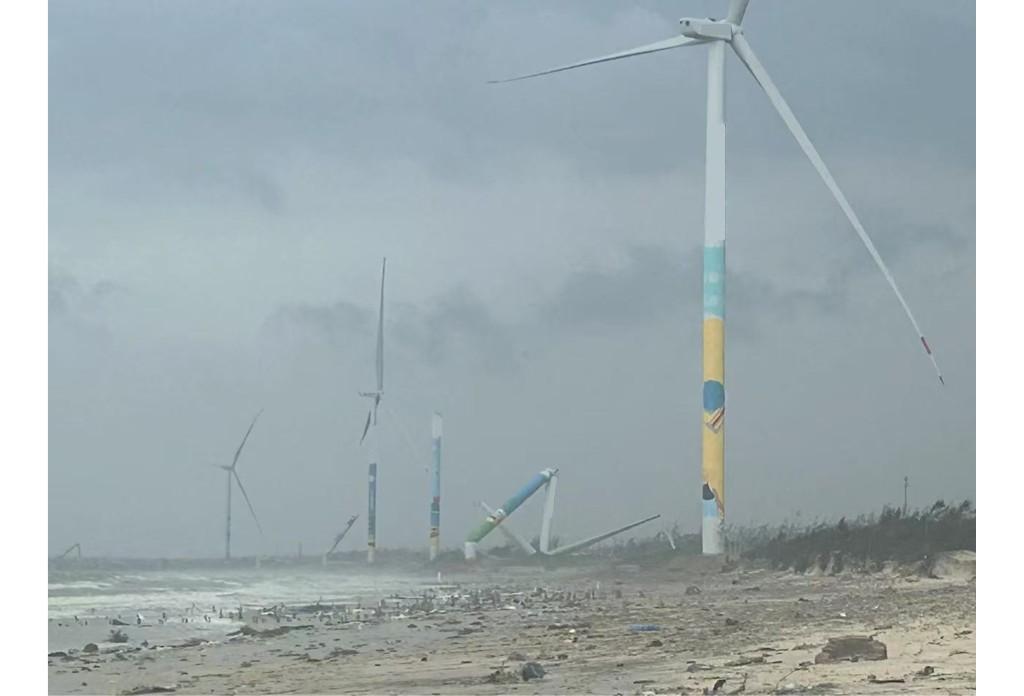
Figure 1. Collapsed wind turbine caused by Super Typhoon Yagi
Key findings show a global oceanic U₅₀ increase of 0.016 m s⁻¹ per year (p < 0.01), with positive trends in 62.85% of coastal grid cells. Regionally, U₅₀ values exceed 37.5 m s⁻¹—the design limit for the most common Class III turbines—in 36.7% of ocean areas, concentrated along tropical cyclone paths and high-latitude storm tracks such as the North Atlantic, Northeastern Pacific, and Southern Westerlies (Figure 2).
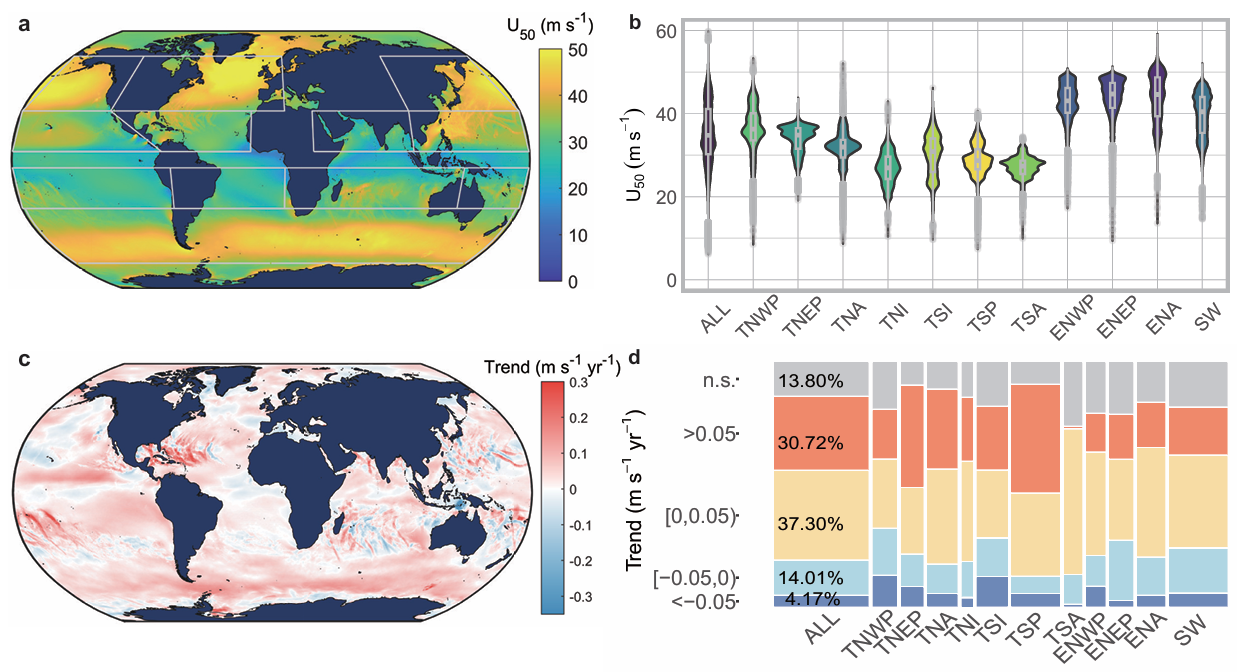
Figure 2. Spatial distribution and trend of the fifty-year return period wind speed
Critically, over 40% of commissioned and planned offshore wind farms in Asia and Europe have already recorded wind speeds surpassing this Class III threshold (Figure 3). More than half of these sites are located in zones exhibiting upward U₅₀ trends, linked to shifts in tropical and extratropical cyclone behavior driven by warming sea surface temperatures, enhanced latent heat release, and altered atmospheric circulation.
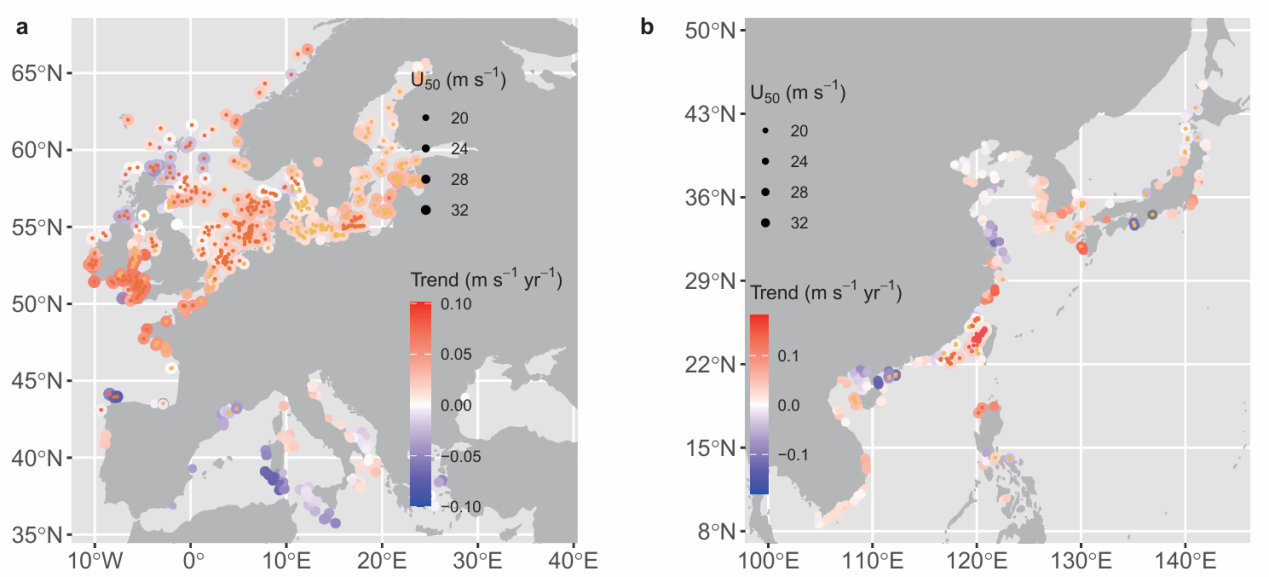
Figure 3. The fifty-year return period wind speed and its trend in offshore development zones
These trends underscore the pressing need to integrate climate change projections into the evaluation of turbine specifications and site selections, thereby mitigating potential economic losses and risks to energy supply stability arising from intensifying extreme winds.
Joint Ph.D. student Yanan Zhao of The Hong Kong Polytechnic University (PolyU) and Eastern Institute of Technology, Ningbo (EIT), and formerly an undergraduate of the School of Environmental Science and Engineering at SUSTech, is the first author of the paper. The corresponding authors include Professor Zhenzhong Zeng, Yiheng Tao from the World Bank Group, Yuntian Chen from EIT, and Jinyue Yan from PolyU.
2026-03-10
2026-09-08
A delegation of 13 students from Southern University of Science and Technology (SUSTech), Zhejiang University and the University of Science and Technology of China (USTC), accompanied by four SUSTech faculty members including including two affiliated with the State Key Laboratory of Soil Pollution Control and Safety, concluded a 12-day summer school at Flinders University in August, 2026, hosted by the University’s National Centre for Groundwater Research and Training (NCGRT).Throughout the program, the students participated in a wide range of educational activities covering water resources, environmental health, groundwater modeling, managed aquifer recharge, salinity management, mining sites management, virtual reality hydrology, and nature-based solutions for surface water, groundwater and soil pollution.A highlight of the visit was a series of field trips showcasing South Australia’s unique natural environments. These included an overnight excursion to a global showcase of integrated surface and groundwater management exemplified by the Murray-Darling Basin. Visits to the St Kilda Mangroves highlighted ecohydrological approaches to coastal mangrove conservation. While Hallett Cove featured the most famous glacial striation on pre-Cambrian rocks. Happy Valley Reservoir, Oaklands Wetland, and Port Willunga Beach, with their wildlife, water management and well-exposed sedimentary rock formations, left strong impressions on our students. Students also attended research seminars and explored Flinders University’s teaching and research facilities.This summer school provided an excellent opportunity for students to engage with Flinders University staff, students, and researchers, experience Australian approaches to soil and groundwater pollution control and safety research, and strengthen the institutional ties between SUSTech and Flinders University, while fostering international connections and cross-cultural learning. The visit was made possible through a combination of support provided by SUSTech and the Fundamental and Interdisciplinary Disciplines Breakthrough Plan of the Ministry of Education of China(JYB2025XDXM909).During the visit, Chair Professor Yan ZHENG from SUSTech delivered a research seminar on arsenic detection in the developed and developing world. Flinders University noted that its academic community was privileged to learn from her expertise.SUSTech expresses its gratitude for the incredible partnership with Flinders University at the conclusion of the program.
2026-04-22
On April 22, the Frontiers Planet Prize announced its list of 25 National Champions for 2026. Hong WANG, a 2025 graduate of the School of Environmental Science and Engineering at the Southern Universi
2026-04-20
On the morning of April 17, 2026, a delegation from Flinders University (Australia), led by Professor Colin Stirling, President of Flinders University, visited the Southern University of Science and T
2026-04-08
Hydrological models are foundational tools for water resource management, agricultural planning, flood and drought mitigation, and ecosystem protection. A long-standing challenge in hydrology is devel
 |