

© 2026 All Rights Reserved. 粤ICP备14051456号
2023-06-19
View:8
Since the 1980s, a remarkable global phenomenon known as “earth greening” (i.e., vegetation increase) has been observed, which has been primarily attributed to factors such as CO2 fertilization, changes in climatic conditions, and atmospheric nitrogen deposition. This greening trend has also manifested in the restoration of grass vegetation in the arid regions of northwest China. However, a comprehensive understanding of the underlying mechanisms driving this recovery has been lacking, emphasizing the need for a systematic and quantitative analysis.
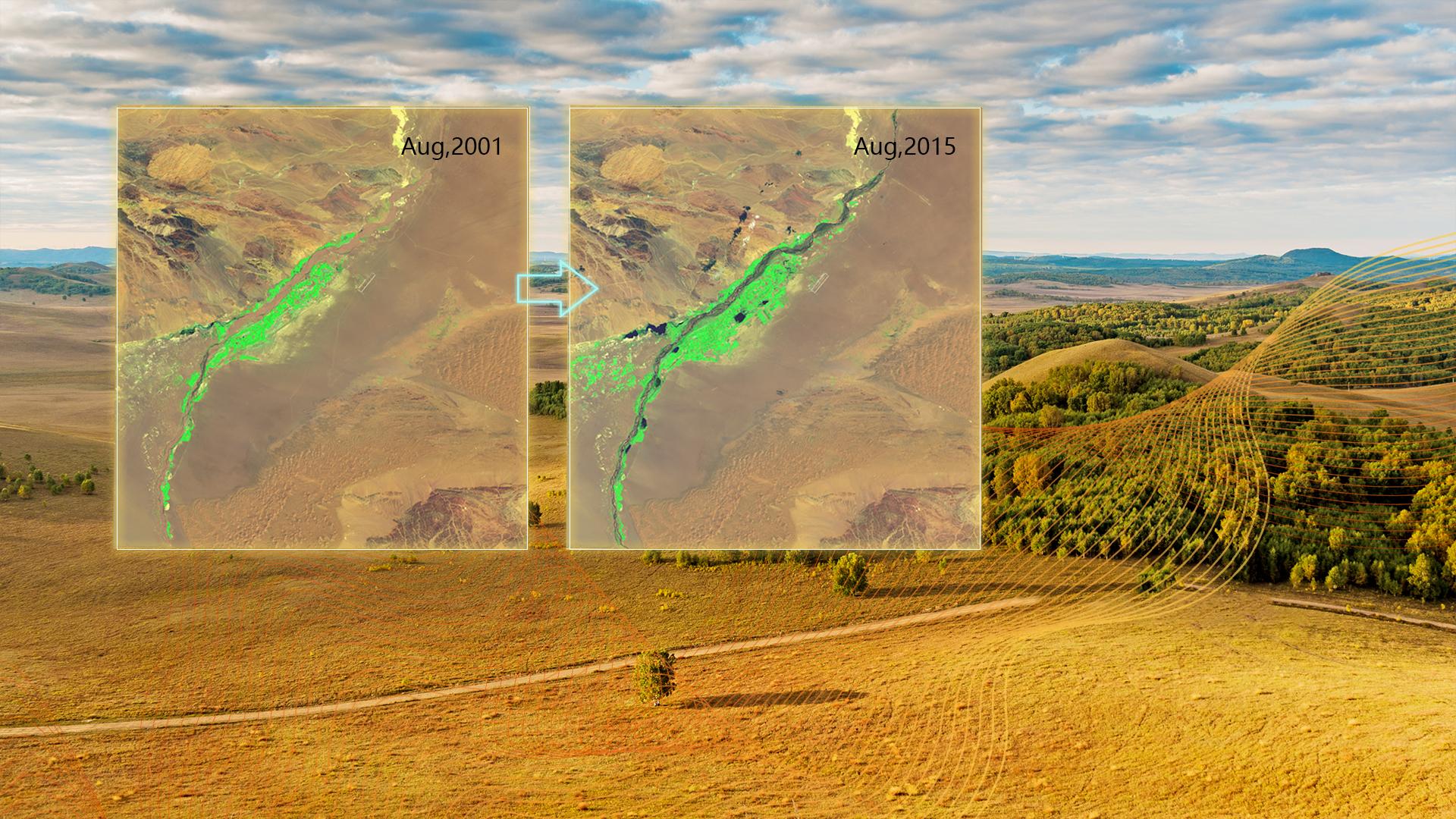
Professor Yi Zheng’s research team from the School of Environmental Science and Engineering (ESE) at the Southern University of Science and Technology (SUSTech) has recently published a paper that tackles the challenge of predicting grassland coverage evolution using deep learning techniques and unveils the mechanisms of earth greening in endorheic arid regions.
The paper, entitled “Ecological Flow Management Identified as Leading Driver of Grassland Greening in the Gobi Desert Using Deep Learning”, has been published in Geophysical Research Letters, an internationally renowned journal of geoscience.
This study utilized Landsat-7 ETM+ imagery, spanning the growing seasons from 2001 to 2015, as an original data source for remote sensing interpretation of grass fractional vegetation cover (FVC). By leveraging the forcing data provided by HEIFLOW, an ecohydrological model, and RIEMS, a regional climate model, they developed a Convolutional Long Short-Term Memory (ConvLSTM) model to forecast FVC dynamics in the Gobi Desert region of the lower Heihe River Basin (HRB) (Fig. 1). HRB is the second largest endorheic river basin in China and has been used as a testbed for watershed science since the 1980s.
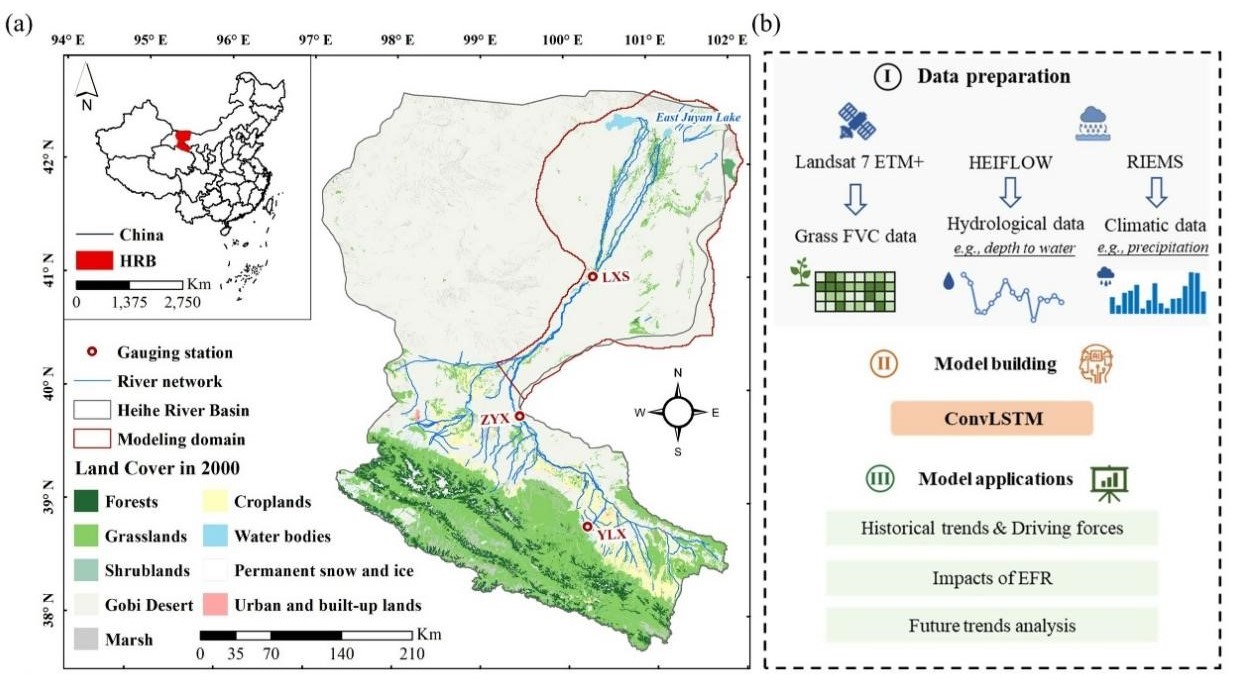
Figure 1. Study area and overall workflow. (a) The Heihe River Basin and the modeling domain, (b) major research steps.
The study reveals that coupled with extensive remote sensing data, the deep learning model, ConvLSTM, enables precise characterization of the evolving patterns of grass FVC in the study area at a 1-km resolution (R2 = 0.92). Moreover, the model demonstrates remarkable effectiveness in predicting extreme transitions between conversions of bare land and grassland (R2 = 0.74). These predictive accuracies surpass what can be achieved by existing process-driven modeling approaches, highlighting the superiority of the ConvLSTM model proposed in this study.
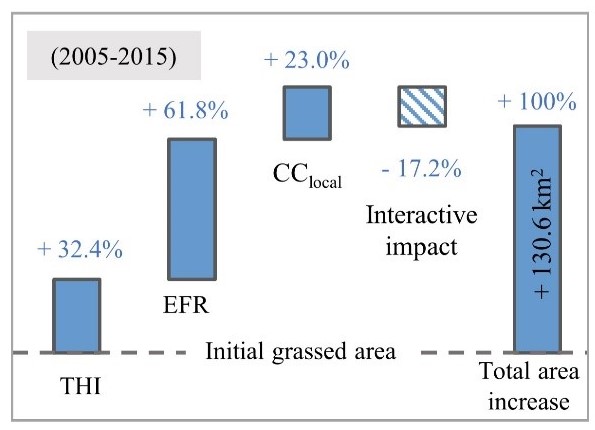
Figure 2. The underlying mechanisms of changes in grass FVC.
Between 2001 and 2015, the study area experienced a notable increase in grassland area, expanding by approximately 30% from 568 km2 to 741 km2. Attribution analysis based on ConvLSTM revealed that 62% of the observed vegetation changes can be attributed to ecological flow regulation (EFR) implemented in the basin since 2000, nearly triple the contribution of local climate change (+23%). The transboundary hydrological impact (THI) due to the natural hydrological changes in the upstream area (+32%) also played an important role. Both EFR and THI contributed to the changes by restoring groundwater levels in the study area.
This study provides a quantitative identification of the mechanism of grassland restoration, highlighting the impacts of ecological flow management and transboundary flows. The findings expand the existing understanding of the global greening process and demonstrate the significant potential of artificial intelligence based on big data in ecohydrological research. The results also have important implications for vegetation restoration and water resource management in arid regions.
Ph.D. student Siqi Li from the School of ESE at SUSTech is the first author of this paper. Professor Yi Zheng is the corresponding author, and SUSTech is the first affiliation. Other co-authors include Research Associate Professor Feng Han and Research Assistant Professor Peng Xu, both from the School of ESE at SUSTech, and Research Scientist Anping Chen of Colorado State University.
This study was supported by the Strategic Priority Research Program of the Chinese Academy of Sciences and the National Natural Science Foundation of China (NSFC).
Paper link: https://doi.org/10.1029/2023GL103369
2026-03-10
2026-09-08
A delegation of 13 students from Southern University of Science and Technology (SUSTech), Zhejiang University and the University of Science and Technology of China (USTC), accompanied by four SUSTech faculty members including including two affiliated with the State Key Laboratory of Soil Pollution Control and Safety, concluded a 12-day summer school at Flinders University in August, 2026, hosted by the University’s National Centre for Groundwater Research and Training (NCGRT).Throughout the program, the students participated in a wide range of educational activities covering water resources, environmental health, groundwater modeling, managed aquifer recharge, salinity management, mining sites management, virtual reality hydrology, and nature-based solutions for surface water, groundwater and soil pollution.A highlight of the visit was a series of field trips showcasing South Australia’s unique natural environments. These included an overnight excursion to a global showcase of integrated surface and groundwater management exemplified by the Murray-Darling Basin. Visits to the St Kilda Mangroves highlighted ecohydrological approaches to coastal mangrove conservation. While Hallett Cove featured the most famous glacial striation on pre-Cambrian rocks. Happy Valley Reservoir, Oaklands Wetland, and Port Willunga Beach, with their wildlife, water management and well-exposed sedimentary rock formations, left strong impressions on our students. Students also attended research seminars and explored Flinders University’s teaching and research facilities.This summer school provided an excellent opportunity for students to engage with Flinders University staff, students, and researchers, experience Australian approaches to soil and groundwater pollution control and safety research, and strengthen the institutional ties between SUSTech and Flinders University, while fostering international connections and cross-cultural learning. The visit was made possible through a combination of support provided by SUSTech and the Fundamental and Interdisciplinary Disciplines Breakthrough Plan of the Ministry of Education of China(JYB2025XDXM909).During the visit, Chair Professor Yan ZHENG from SUSTech delivered a research seminar on arsenic detection in the developed and developing world. Flinders University noted that its academic community was privileged to learn from her expertise.SUSTech expresses its gratitude for the incredible partnership with Flinders University at the conclusion of the program.
2026-04-22
On April 22, the Frontiers Planet Prize announced its list of 25 National Champions for 2026. Hong WANG, a 2025 graduate of the School of Environmental Science and Engineering at the Southern Universi
2026-04-20
On the morning of April 17, 2026, a delegation from Flinders University (Australia), led by Professor Colin Stirling, President of Flinders University, visited the Southern University of Science and T
2026-04-08
Hydrological models are foundational tools for water resource management, agricultural planning, flood and drought mitigation, and ecosystem protection. A long-standing challenge in hydrology is devel
 |