

© 2026 All Rights Reserved. 粤ICP备14051456号
2023-06-27
View:8
Long-term exposure to ozone increases the risk of premature mortality from respiratory causes. Ozone pollution in Asia, however, has been worsening in the last decade, resulting from rapid urbanization and industrialization.
The alarming ozone pollution in Asia calls for better understanding and forecasting from air quality models. Observing air quality from space is entering a new era of geostationary satellites, marked by the launch of the Geostationary Environment Monitoring Spectrometer (GEMS) on February 2020.
Assistant Professor Lei Zhu’s research group from the School of Environmental Science and Engineering (ESE) at the Southern University of Science and Technology (SUSTech) investigates the benefit of multiple ozone observations from the GEMS geostationary satellite, low Earth orbit (LEO) satellite, and surface networks on summertime ozone simulations through individual or joint data assimilation, built on their previous work.
Their paper, entitled “Improving ozone simulations in Asia via multisource data assimilation: results from an observing system simulation experiment with GEMS geostationary satellite observations”, has been published in Atmospheric Chemistry and Physics, a prestigious journal dedicated to investigating the Earth’s atmosphere and the underlying chemical and physical processes.
In comparison to GEMS, the retrieval quality of LEO is significantly better, above 200 hPa for representing the stratosphere and upper troposphere. GEMS has stronger vertical sensitivity and smaller retrieval errors relative to LEO at each layer below 200 hPa, providing sufficient measurement information to characterize tropospheric and near-surface ozone. Specifically, GEMS has more potential to capture the hot spots and diurnal evolution of ozone pollution in East Asia.
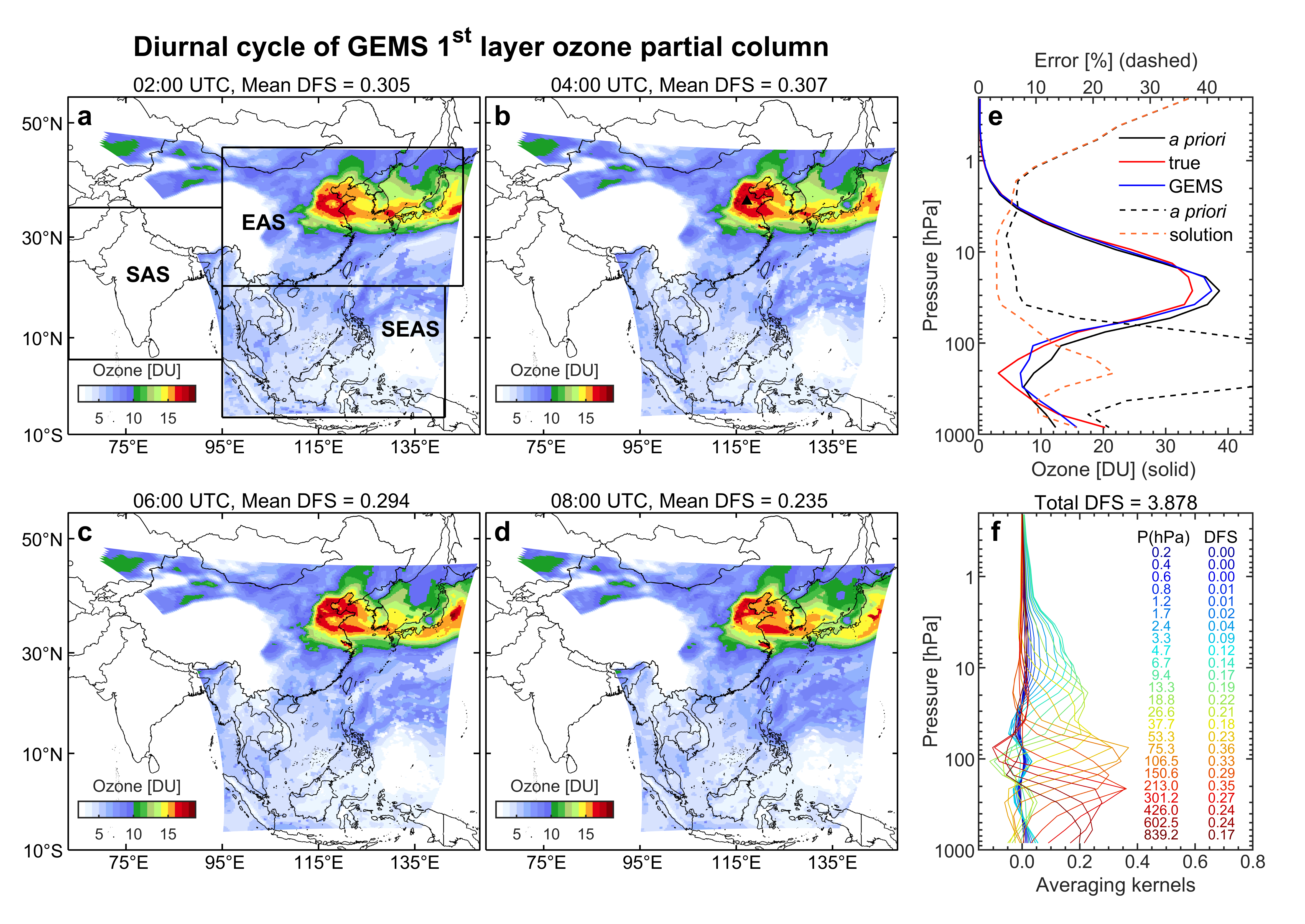
Figure 1. Example of diurnal cycles of surface-layer ozone partial column from GEMS
The researchers found that data assimilation improves the monitoring of exceedance, spatial patterns, and diurnal variations of surface ozone, with a regional mean negative bias reduction from 2.1 to 0.2–1.2 ppbv in ozone simulations in most Asian countries. GEMS also brings direct added value for better-reproducing ozone vertical distributions, especially in the middle to upper troposphere at low latitudes. However, GEMS may mask the added value of LEO measurements, which are crucial to constrain surface and upper tropospheric ozone simulations when observations from other platforms are inadequate.
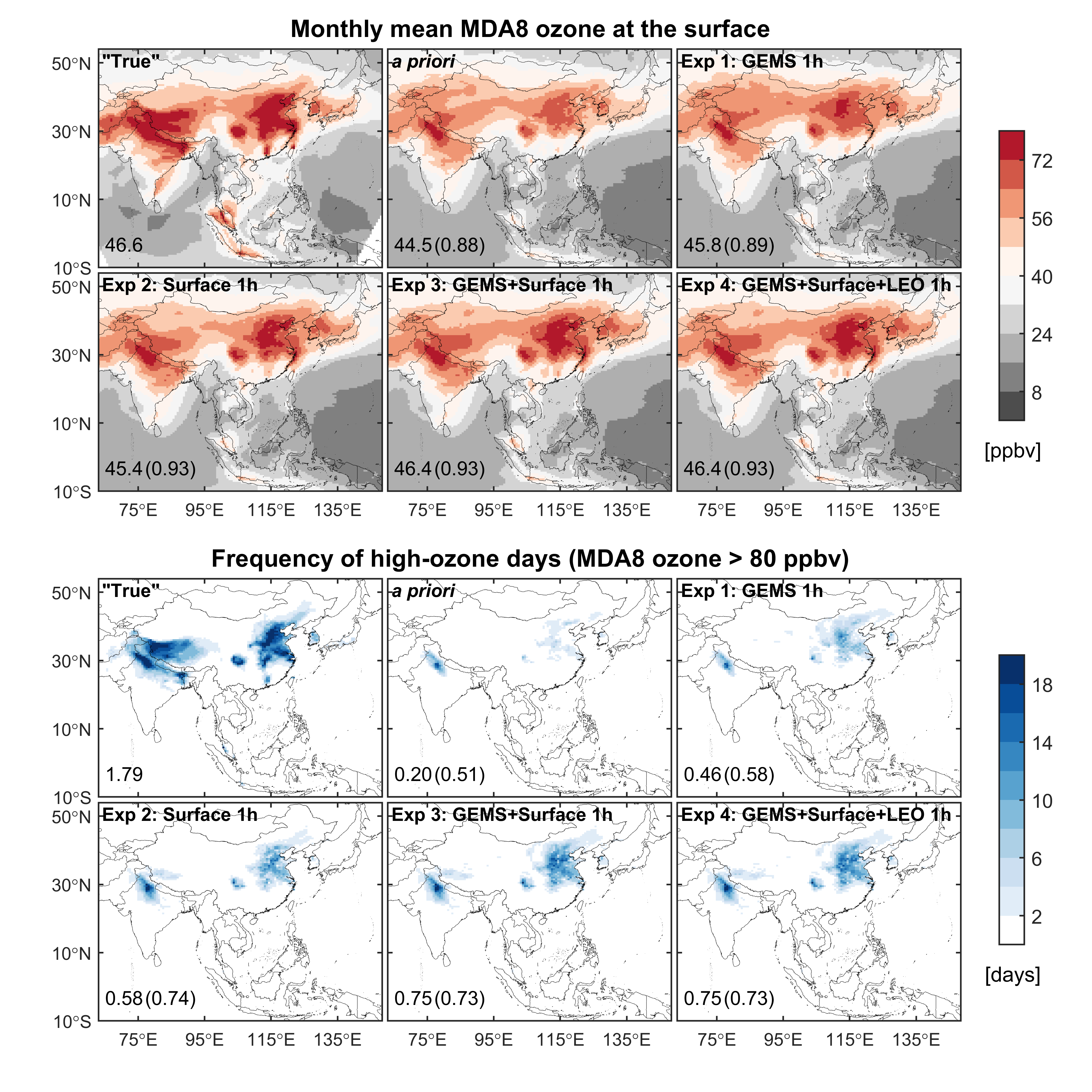
Figure 2. Improved ozone simulations via assimilating different data sets
The improvements introduced by the multisource data assimilation using GEMS geostationary observations are promising, although the data assimilation experiments still have difficulty reproducing the observed ozone features fully. This study provides a valuable reference for ozone data assimilation as multisource observations become gradually available in the era of geostationary satellites.
Dr. Lei Shu of the School of ESE at SUSTech is the first author of this paper. Asst. Prof. Lei Zhu is the corresponding author, and SUSTech is the first corresponding unit.
This study was supported by the Key-Area Research and Development Program of Guangdong Province, Guangdong Basic and Applied Basic Research Foundation, Guangdong Basic and Applied Basic Research Fund, Guangdong University Research Project Science Team, Shenzhen Science and Technology Program, and the China Postdoctoral Science Foundation.
Paper link: https://acp.copernicus.org/articles/23/3731/2023/
2026-03-10
2026-09-08
A delegation of 13 students from Southern University of Science and Technology (SUSTech), Zhejiang University and the University of Science and Technology of China (USTC), accompanied by four SUSTech faculty members including including two affiliated with the State Key Laboratory of Soil Pollution Control and Safety, concluded a 12-day summer school at Flinders University in August, 2026, hosted by the University’s National Centre for Groundwater Research and Training (NCGRT).Throughout the program, the students participated in a wide range of educational activities covering water resources, environmental health, groundwater modeling, managed aquifer recharge, salinity management, mining sites management, virtual reality hydrology, and nature-based solutions for surface water, groundwater and soil pollution.A highlight of the visit was a series of field trips showcasing South Australia’s unique natural environments. These included an overnight excursion to a global showcase of integrated surface and groundwater management exemplified by the Murray-Darling Basin. Visits to the St Kilda Mangroves highlighted ecohydrological approaches to coastal mangrove conservation. While Hallett Cove featured the most famous glacial striation on pre-Cambrian rocks. Happy Valley Reservoir, Oaklands Wetland, and Port Willunga Beach, with their wildlife, water management and well-exposed sedimentary rock formations, left strong impressions on our students. Students also attended research seminars and explored Flinders University’s teaching and research facilities.This summer school provided an excellent opportunity for students to engage with Flinders University staff, students, and researchers, experience Australian approaches to soil and groundwater pollution control and safety research, and strengthen the institutional ties between SUSTech and Flinders University, while fostering international connections and cross-cultural learning. The visit was made possible through a combination of support provided by SUSTech and the Fundamental and Interdisciplinary Disciplines Breakthrough Plan of the Ministry of Education of China(JYB2025XDXM909).During the visit, Chair Professor Yan ZHENG from SUSTech delivered a research seminar on arsenic detection in the developed and developing world. Flinders University noted that its academic community was privileged to learn from her expertise.SUSTech expresses its gratitude for the incredible partnership with Flinders University at the conclusion of the program.
2026-04-22
On April 22, the Frontiers Planet Prize announced its list of 25 National Champions for 2026. Hong WANG, a 2025 graduate of the School of Environmental Science and Engineering at the Southern Universi
2026-04-20
On the morning of April 17, 2026, a delegation from Flinders University (Australia), led by Professor Colin Stirling, President of Flinders University, visited the Southern University of Science and T
2026-04-08
Hydrological models are foundational tools for water resource management, agricultural planning, flood and drought mitigation, and ecosystem protection. A long-standing challenge in hydrology is devel
 |