

© 2026 All Rights Reserved. 粤ICP备14051456号
2023-08-18
View:13
Cadmium (Cd) is considered an environmental pollutant, which often accumulates in rice fields. How to remediate and manage soil containing cadmium is a hot issue in China. Iron (Fe) oxides and fulvic acid (FA) are the key components affecting the fate of cadmium in soil.
The presence of FA influences Fe mineral transformation, and FA may complicate phase transformation and the dynamic behavior of Cd. However, there is still a lack of quantitative understanding of how varying Fe minerals and FA affect Cd immobilization during the ferrihydrite transformation induced by various Fe(II) concentrations, however, is still lack of quantitative understanding.

Xinyue Shen, an undergraduate student of Chair Professor Chongxuan Liu’s research team from the School of Environmental Science and Engineering (ESE) at the Southern University of Science and Technology (SUSTech), has recently published a paper that built a model for Cd species quantification during phase transformation based on mechanistic insights obtained from batch experiments.
The paper, entitled “Mechanistic and modeling insights into the immobilization of Cd and organic carbon during abiotic transformation of ferrihydrite induced by Fe (II)”, has been published in the Journal of Hazardous Materials, an internationally renowned journal in the field of environmental science and ecology.
Ferrihydrite, a poorly crystalline Fe mineral in soil, can occur phase transformation and transform into other secondary Fe minerals. However, in soils, ferrihydrite usually exists in the form of complexes with organic matter (OM), which complicates the reaction of ferrihydrite and heavy metals. Cadmium, a typical heavy metal in anoxic soil environments, can be fixed by complexes of ferrihydrite and OM through adsorption and co-precipitation. The coprecipitates of ferrihydrite, Cd, and OM (Fh-Cd-OM) are thermodynamically unstable and undergo a phase transformation under the influence of Fe(II).
In this study, the dynamic behaviors of Cd during Fe(II) induced ferrihydrite transformation were investigated through batch experiments, a series of advanced characterizations, and a quantitative model. The XRD and XAS results showed that the activity of Fe(II) redistributed ferrihydrite-associated Cd into more stable Fe oxides, most probably magnetite at high Fe(II) concentration and lepidocrocite at low Fe(II) concentration. The EDS and EELS analyses revealed that no incorporated FA was formed. In contrast, Cd may be immobilized by newly-formed Fe oxides through physical isolation, surface complexation, and incorporation.
These findings expand our understanding of the behavior of Cd at the interfaces of Fe oxide-OM and help develop a predictive model for Cd cycling by coupling other redox and chemical processes.
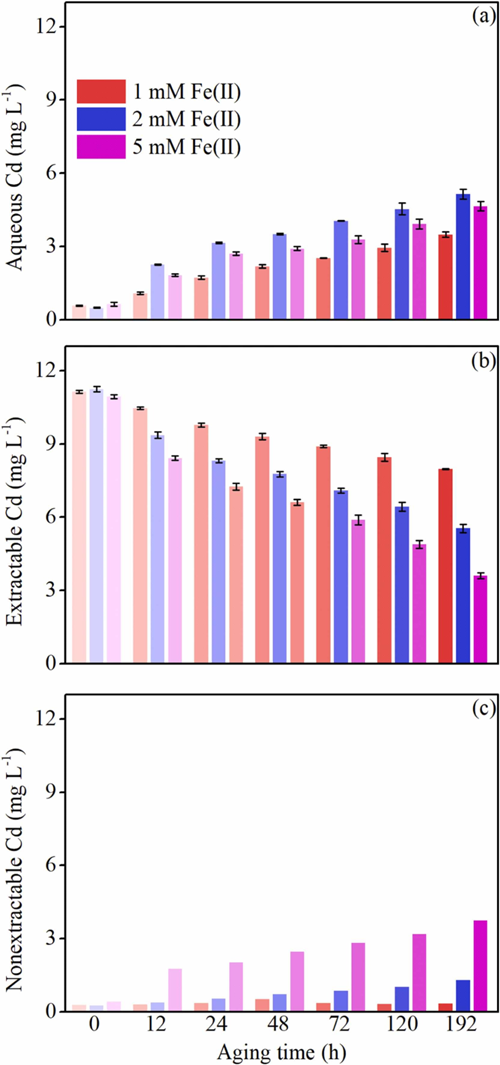
Figure 1. Time-dependent of (a) aqueous Cd, (b) extractable Cd, and (c) nonextractable Cd concentrations during Fe(II)-catalyzed ferrihydrite transformation quantified by batch extraction experiments.
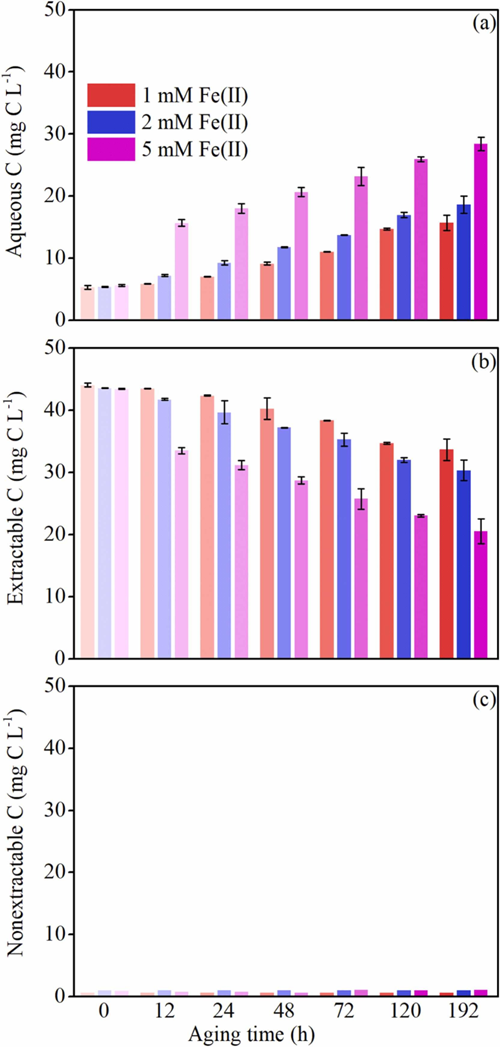
Figure 2. Time-dependent of (a) aqueous C, (b) extractable C, and (c) nonextractable C concentrations during Fe(II)-catalyzed ferrihydrite transformation quantified by batch extraction experiments.
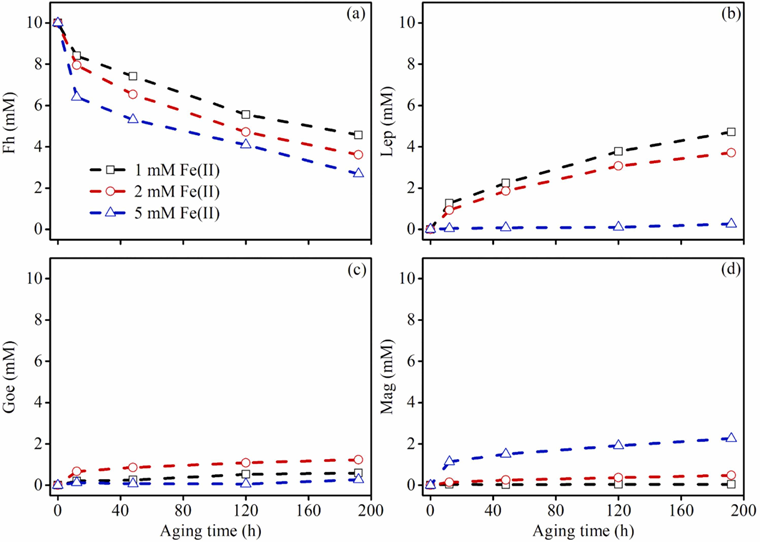
Figure 3. The concentrations of Fe oxide formed at various aging times determined by EXAFS LCF analysis for Fh-Cd-FA treatments. (a) ferrihydrite, (b) lepidocrocite, (c) goethite, and (d) magnetite.
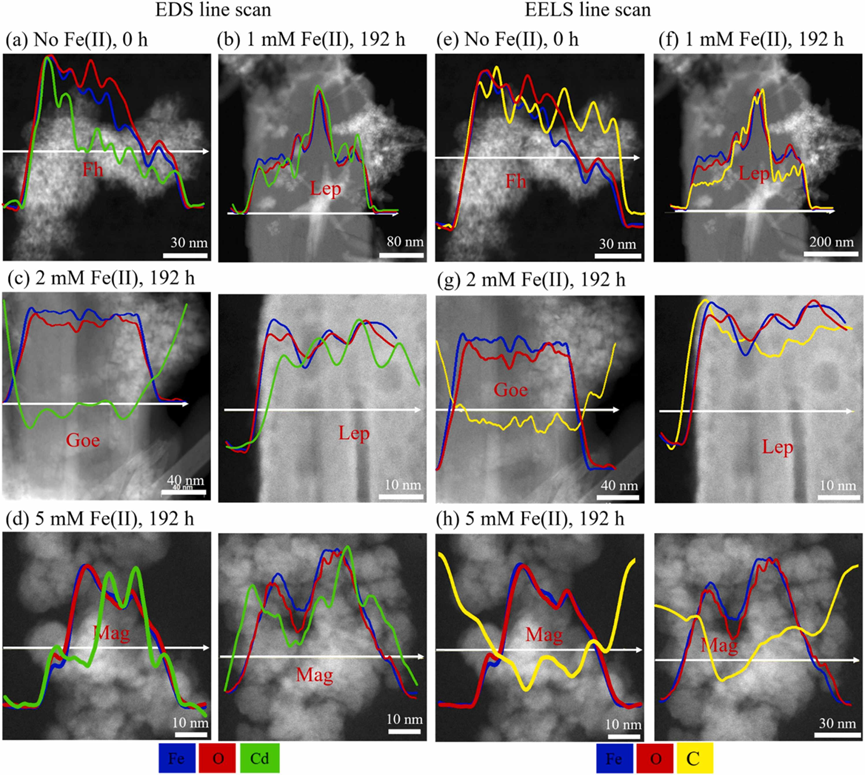
Figure 4. EDS and EELS line scans of Fe(blue), O(red), Cd(green), and C(yellow) in Fh-Cd-FA treatments.
Undergraduate student Xinyue Shen and master’s student Huiyan Zhu from the School of ESE at SUSTech are the co-first authors of this paper. Chair Professor Chongxuan Liu and postdoctoral student Shiwen Hu are the corresponding authors, and SUSTech is the first affiliation of the paper.
This work was supported by the Guangdong Basic and Applied Basic Research Foundation, China Postdoctoral Science Foundation, and the National Natural Science Foundation of China (NSFC).
Paper link: https://www.sciencedirect.com/science/article/pii/S0304389422010068
2026-03-10
2026-09-08
A delegation of 13 students from Southern University of Science and Technology (SUSTech), Zhejiang University and the University of Science and Technology of China (USTC), accompanied by four SUSTech faculty members including including two affiliated with the State Key Laboratory of Soil Pollution Control and Safety, concluded a 12-day summer school at Flinders University in August, 2026, hosted by the University’s National Centre for Groundwater Research and Training (NCGRT).Throughout the program, the students participated in a wide range of educational activities covering water resources, environmental health, groundwater modeling, managed aquifer recharge, salinity management, mining sites management, virtual reality hydrology, and nature-based solutions for surface water, groundwater and soil pollution.A highlight of the visit was a series of field trips showcasing South Australia’s unique natural environments. These included an overnight excursion to a global showcase of integrated surface and groundwater management exemplified by the Murray-Darling Basin. Visits to the St Kilda Mangroves highlighted ecohydrological approaches to coastal mangrove conservation. While Hallett Cove featured the most famous glacial striation on pre-Cambrian rocks. Happy Valley Reservoir, Oaklands Wetland, and Port Willunga Beach, with their wildlife, water management and well-exposed sedimentary rock formations, left strong impressions on our students. Students also attended research seminars and explored Flinders University’s teaching and research facilities.This summer school provided an excellent opportunity for students to engage with Flinders University staff, students, and researchers, experience Australian approaches to soil and groundwater pollution control and safety research, and strengthen the institutional ties between SUSTech and Flinders University, while fostering international connections and cross-cultural learning. The visit was made possible through a combination of support provided by SUSTech and the Fundamental and Interdisciplinary Disciplines Breakthrough Plan of the Ministry of Education of China(JYB2025XDXM909).During the visit, Chair Professor Yan ZHENG from SUSTech delivered a research seminar on arsenic detection in the developed and developing world. Flinders University noted that its academic community was privileged to learn from her expertise.SUSTech expresses its gratitude for the incredible partnership with Flinders University at the conclusion of the program.
2026-04-22
On April 22, the Frontiers Planet Prize announced its list of 25 National Champions for 2026. Hong WANG, a 2025 graduate of the School of Environmental Science and Engineering at the Southern Universi
2026-04-20
On the morning of April 17, 2026, a delegation from Flinders University (Australia), led by Professor Colin Stirling, President of Flinders University, visited the Southern University of Science and T
2026-04-08
Hydrological models are foundational tools for water resource management, agricultural planning, flood and drought mitigation, and ecosystem protection. A long-standing challenge in hydrology is devel
 |