

© 2026 All Rights Reserved. 粤ICP备14051456号
2024-04-30
View:20
In recent years, with the accumulation of Earth’s big data, data-driven methods represented by deep learning have surpassed traditional hydrological models in simulation accuracy. Still, the black-box nature and lack of physical mechanisms have limited wider applications of deep learning in hydrological modeling and water resource management.
The integration of deep learning and physical process models is currently at the forefront of geoscience, and encoding physical knowledge directly into deep neural networks for differentiable modeling is the most promising development direction. In the field of hydrological modeling, lumped hydrological models have been successfully encoded into deep neural networks. However, encoding of distributed hydrological models, which are more widely used, is still a challenge.

Professor Yi Zheng’s research group from the School of Environmental Science and Engineering (ESE) at the Southern University of Science and Technology has recently proposed a novel approach for encoding distributed hydrological models in deep neural networks and performing multi-task learning.
Their work, entitled “Distributed Hydrological Modeling With Physics-Encoded Deep Learning: A General Framework and Its Application in the Amazon”, has been published in the journal Water Resources Research.
The group successfully addressed the issue of performing river routing in deep neural networks and proposed a differentiable modeling framework for distributed hydrological modeling (Fig. 1). The framework merges three neural network modules: the physical NN (i.e., the encoded distributed hydrological model), the replacement NN (to characterize the processes that are not or cannot be accurately represented in the hydrological model), and the parameterization NN (to achieve the spatial mapping from the geographic attributes to the hydrological model parameters). The framework is not only capable of global backpropagation and joint optimization, but also of multi-task learning.
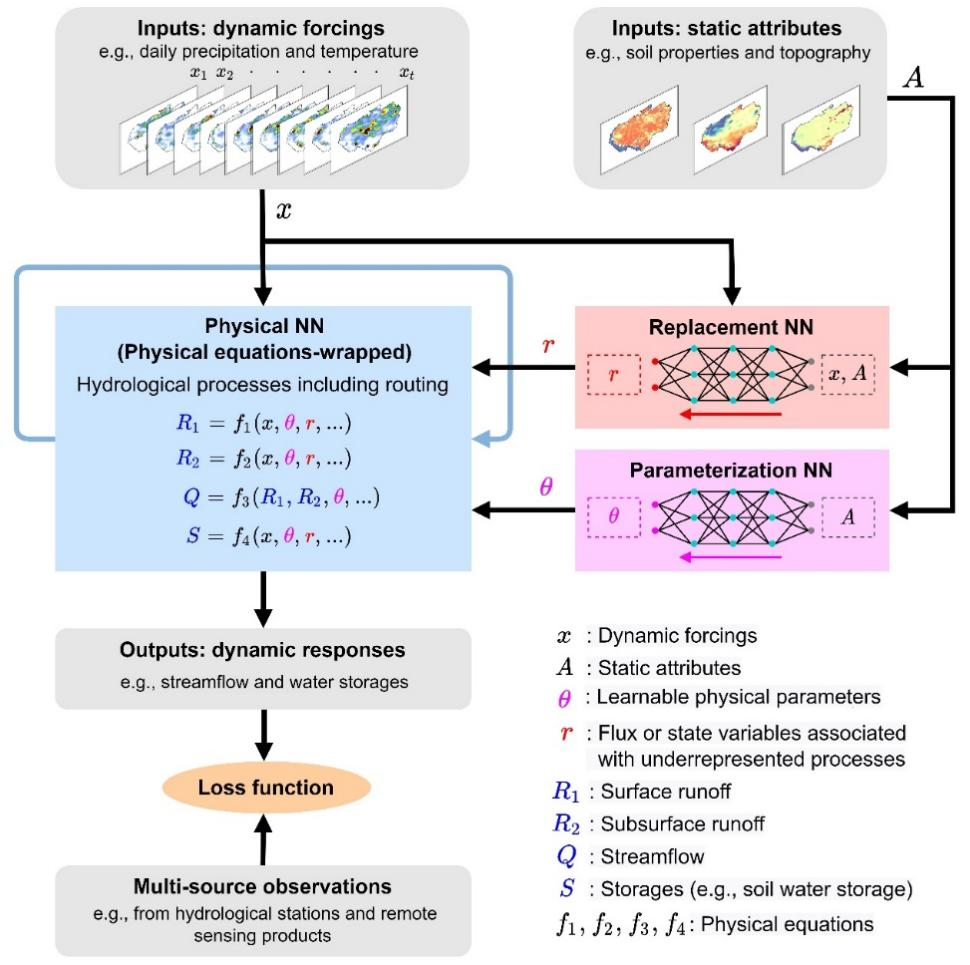
Figure 1. The differentiable modeling framework for distributed hydrological modeling
Based on the new framework, the researchers constructed a deep learning model, Hybrid(Q,S)+, for the Amazon Basin, the largest river system on Earth (approximately 6 million square kilometers), using the globally distributed hydrological model HydroPy as the physical core. The results demonstrate that the new model outperforms the original HydroPy model in terms of streamflow and terrestrial water storage simulations, with improvements of 41% and 35% in accuracy, respectively, under the joint constraints of streamflow observations and GRACE satellite data (Fig. 2).
For hydrological processes that are challenging to observe directly, or where the scale of observations does not match the model, deep learning models that incorporate physical knowledge are able to provide new insights. For example, the estimation of evapotranspiration (ET) has consistently been a challenging issue in hydrological studies. The potential ET derived from the Hybrid(Q,S)+ model inference in this study is more self-compatible with streamflow observations and GRACE satellite data, and exhibits more visible spatiotemporal variability than the traditional methods (Fig. 3). In addition, this work employed the SHapley Additive exPlanations (SHAP) model to interpret the parameterization NN, thereby identifying the geographic attributes that regulate the spatial variability of key parameters.
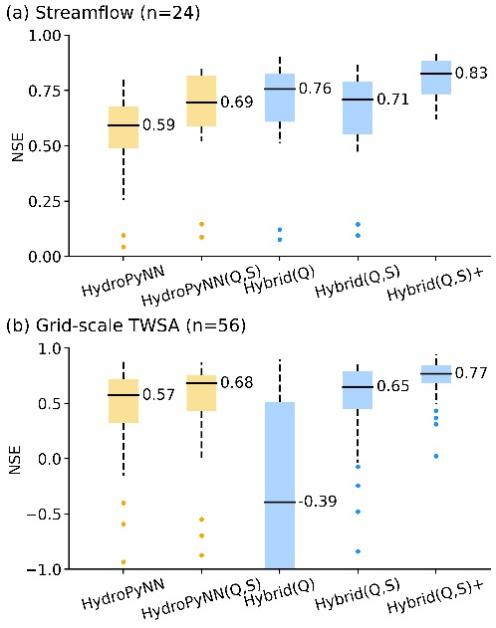
Figure 2. The benchmarking results of the simulation accuracy of the new model Hybrid(Q,S)+. HydroPyNN represents the original globally distributed hydrological model HydroPy
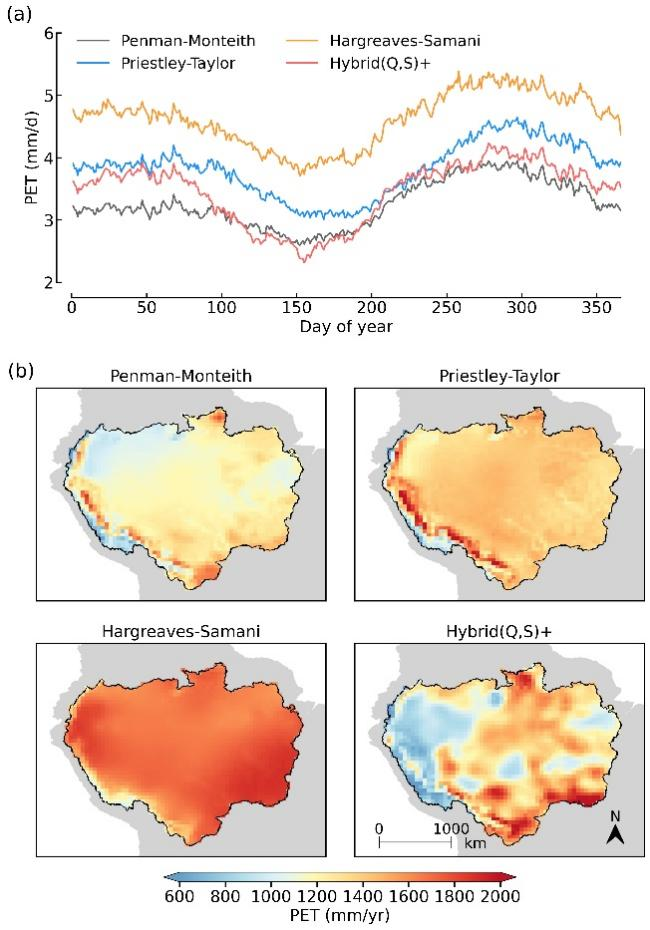
Figure 3. The estimated potential evapotranspiration from the new model Hybrid(Q,S)+ shows highly visible spatiotemporal variability
The differentiable modeling framework proposed in this study significantly improves the computational efficiency and accuracy of large-scale distributed hydrological modeling. It opens a new path for the development of distributed hydrological modeling in the era of big data.
Ph.D. student Chao Wang from the School of ESE at SUSTech is the first author of the paper. Professor Yi Zheng is the corresponding author, and SUSTech is the first affiliated institution of the paper. Other co-authors of this work include Dr. Shijie Jiang from the Max Planck Institute for Biogeochemistry in Germany and Research Associate Professor Feng Han from the School of ESE at SUSTech.
The study was supported by the National Natural Science Foundation of China. The authors also acknowledge the assistance of the Center for Computational Science and Engineering at SUSTech for providing computing resources.
Paper link: https://doi.org/10.1029/2023WR036170
2026-03-10
2026-09-08
A delegation of 13 students from Southern University of Science and Technology (SUSTech), Zhejiang University and the University of Science and Technology of China (USTC), accompanied by four SUSTech faculty members including including two affiliated with the State Key Laboratory of Soil Pollution Control and Safety, concluded a 12-day summer school at Flinders University in August, 2026, hosted by the University’s National Centre for Groundwater Research and Training (NCGRT).Throughout the program, the students participated in a wide range of educational activities covering water resources, environmental health, groundwater modeling, managed aquifer recharge, salinity management, mining sites management, virtual reality hydrology, and nature-based solutions for surface water, groundwater and soil pollution.A highlight of the visit was a series of field trips showcasing South Australia’s unique natural environments. These included an overnight excursion to a global showcase of integrated surface and groundwater management exemplified by the Murray-Darling Basin. Visits to the St Kilda Mangroves highlighted ecohydrological approaches to coastal mangrove conservation. While Hallett Cove featured the most famous glacial striation on pre-Cambrian rocks. Happy Valley Reservoir, Oaklands Wetland, and Port Willunga Beach, with their wildlife, water management and well-exposed sedimentary rock formations, left strong impressions on our students. Students also attended research seminars and explored Flinders University’s teaching and research facilities.This summer school provided an excellent opportunity for students to engage with Flinders University staff, students, and researchers, experience Australian approaches to soil and groundwater pollution control and safety research, and strengthen the institutional ties between SUSTech and Flinders University, while fostering international connections and cross-cultural learning. The visit was made possible through a combination of support provided by SUSTech and the Fundamental and Interdisciplinary Disciplines Breakthrough Plan of the Ministry of Education of China(JYB2025XDXM909).During the visit, Chair Professor Yan ZHENG from SUSTech delivered a research seminar on arsenic detection in the developed and developing world. Flinders University noted that its academic community was privileged to learn from her expertise.SUSTech expresses its gratitude for the incredible partnership with Flinders University at the conclusion of the program.
2026-04-22
On April 22, the Frontiers Planet Prize announced its list of 25 National Champions for 2026. Hong WANG, a 2025 graduate of the School of Environmental Science and Engineering at the Southern Universi
2026-04-20
On the morning of April 17, 2026, a delegation from Flinders University (Australia), led by Professor Colin Stirling, President of Flinders University, visited the Southern University of Science and T
2026-04-08
Hydrological models are foundational tools for water resource management, agricultural planning, flood and drought mitigation, and ecosystem protection. A long-standing challenge in hydrology is devel
 |