

© 2026 All Rights Reserved. 粤ICP备14051456号
2024-05-17
View:16
Carbon, a fundamental constituent of terrestrial life, has long captivated attention due to its pivotal role. While previous focus centered on the total carbon content in plant tissues, scant attention was paid to the composition, abundance, and diversity of specific carbon compounds, referred to as molecular-level carbon traits. These traits, including their ecological and evolutionary significance, particularly in the context of the soil’s concealed domain—the fine roots—remained obscure.
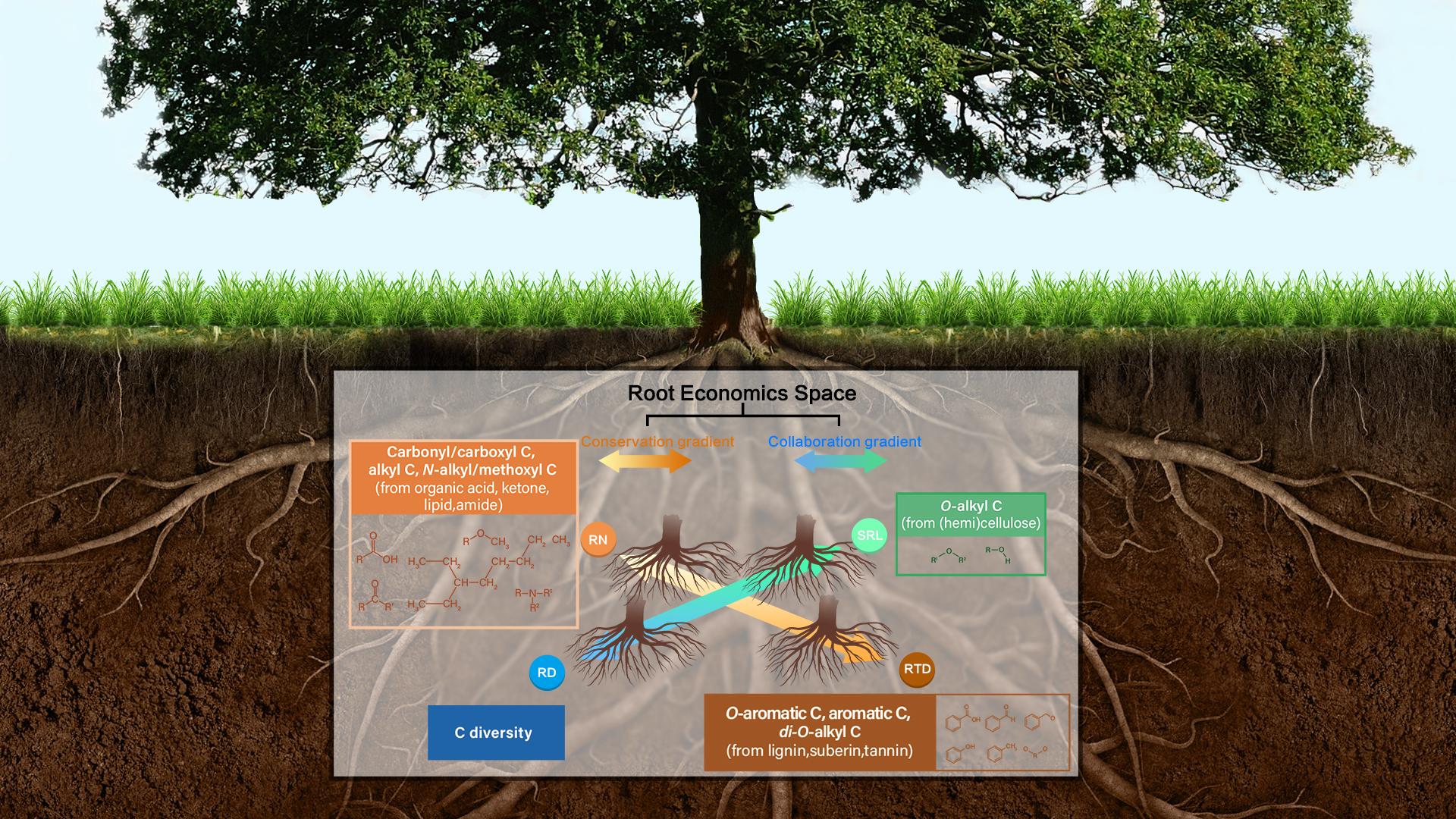
A recent paper by Associate Professor Junjian Wang’s research group from the School of Environmental Science and Engineering at the Southern University of Science and Technology (SUSTech), in collaboration with Professor Deliang Kong’s group from Henan Agricultural University, sheds light on the potential influence of these molecular-level carbon traits on shaping the multidimensional economics space of fine roots.
Collecting fine-root samples from 66 tropical tree species, they employed 13C NMR analysis to quantify the relative abundance of functional groups derived from various carbon compounds. This endeavor established a correlation between these molecular-level carbon traits and commonly measured functional traits of fine roots. Subsequently, the researchers compared and scrutinized their findings with global-scale trait datasets to ascertain the universality of the observed patterns.
Their work, entitled “Molecular-level carbon traits underlie the multidimensional fine root economics space”, has been recently published in the journal Nature Plants.
This study pioneers the identification of two primary dimensions of variation in molecular-level carbon traits, closely intertwined with the widely recognized multidimensional fine root economics space. Given the diverse physiological and ecological functions associated with different carbon compounds, molecular-level carbon traits offer deeper insights into the functionality, diversity, and environmental adaptation of fine roots compared to mere total carbon content.
For instance, plant species with thinner fine roots tend to invest more in O-alkyl carbon to facilitate the “do-it-yourself” soil exploration. Differently, plant species bearing denser fine roots invest more in aromatics and less in nitrogenous or carbonyl-containing compounds, which indicates a slower metabolism and higher defense of the roots.
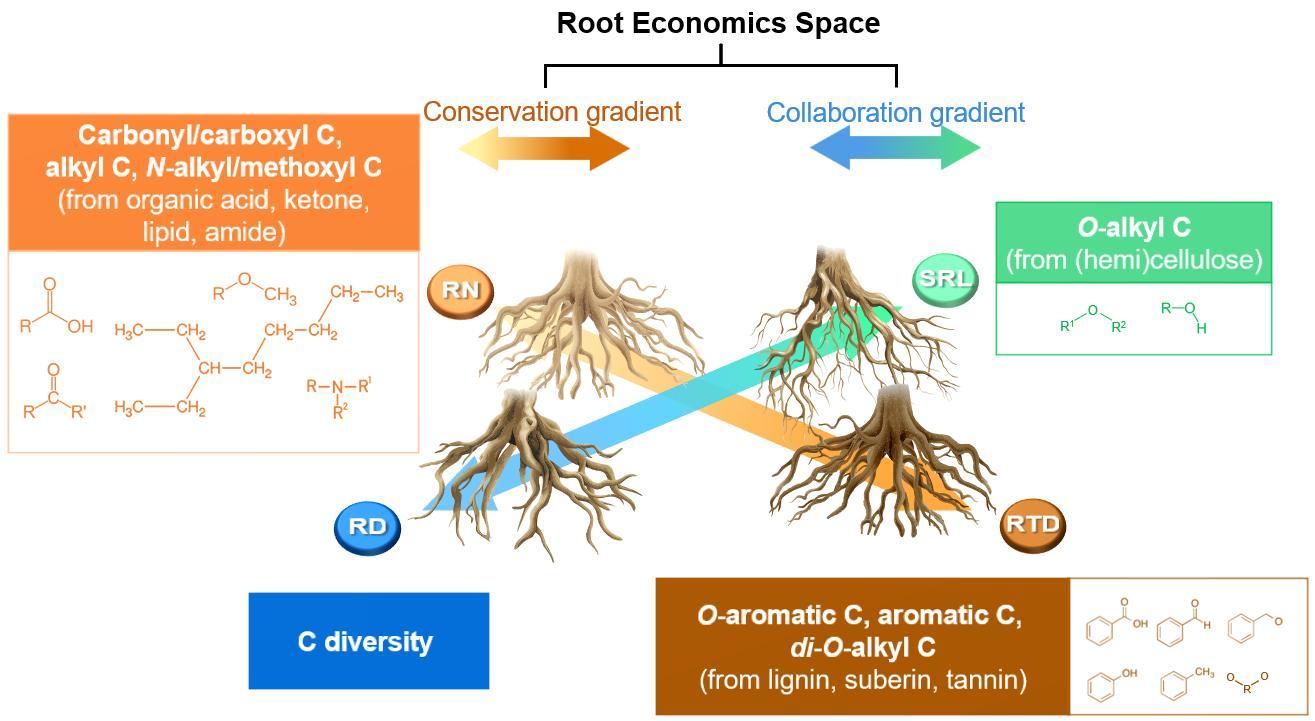
Figure 1. Conceptual framework of the two-dimensional root functional trait space
Additionally, the study unveils a robust correlation between key carbon traits of fine roots, both within the present investigation and across global datasets, and commonly measured functional traits of fine roots. Noteworthy correlations include a positive association between lignin content and root tissue density, and a negative correlation between cellulose and hemicellulose content and root diameter. Therefore, the coupling between molecular-level carbon traits and root economics space may be universal.
These findings illuminate the significant role of molecular-level carbon traits in shaping the fine root economics space. Besides offering novel molecular-level insights into understanding the diversity of plant root morphology and function, it holds profound implications for elucidating plant evolution, species coexistence, and adaptability to heterogeneous environments.
Dr. Mengke Wang from the School of Environmental Science and Engineering at SUSTech is the first author of the paper. Associate Professor Junjian Wang from the School of Environmental Science and Engineering at SUSTech and Professor Deliang Kong from Henan Agricultural University are the co-corresponding authors.
The study was supported by the National Natural Science Foundation of China and the Guangdong Basic and Applied Basic Research Foundation.
Paper link: https://doi.org/10.1038/s41477-024-01700-4
2026-03-10
2026-09-08
A delegation of 13 students from Southern University of Science and Technology (SUSTech), Zhejiang University and the University of Science and Technology of China (USTC), accompanied by four SUSTech faculty members including including two affiliated with the State Key Laboratory of Soil Pollution Control and Safety, concluded a 12-day summer school at Flinders University in August, 2026, hosted by the University’s National Centre for Groundwater Research and Training (NCGRT).Throughout the program, the students participated in a wide range of educational activities covering water resources, environmental health, groundwater modeling, managed aquifer recharge, salinity management, mining sites management, virtual reality hydrology, and nature-based solutions for surface water, groundwater and soil pollution.A highlight of the visit was a series of field trips showcasing South Australia’s unique natural environments. These included an overnight excursion to a global showcase of integrated surface and groundwater management exemplified by the Murray-Darling Basin. Visits to the St Kilda Mangroves highlighted ecohydrological approaches to coastal mangrove conservation. While Hallett Cove featured the most famous glacial striation on pre-Cambrian rocks. Happy Valley Reservoir, Oaklands Wetland, and Port Willunga Beach, with their wildlife, water management and well-exposed sedimentary rock formations, left strong impressions on our students. Students also attended research seminars and explored Flinders University’s teaching and research facilities.This summer school provided an excellent opportunity for students to engage with Flinders University staff, students, and researchers, experience Australian approaches to soil and groundwater pollution control and safety research, and strengthen the institutional ties between SUSTech and Flinders University, while fostering international connections and cross-cultural learning. The visit was made possible through a combination of support provided by SUSTech and the Fundamental and Interdisciplinary Disciplines Breakthrough Plan of the Ministry of Education of China(JYB2025XDXM909).During the visit, Chair Professor Yan ZHENG from SUSTech delivered a research seminar on arsenic detection in the developed and developing world. Flinders University noted that its academic community was privileged to learn from her expertise.SUSTech expresses its gratitude for the incredible partnership with Flinders University at the conclusion of the program.
2026-04-22
On April 22, the Frontiers Planet Prize announced its list of 25 National Champions for 2026. Hong WANG, a 2025 graduate of the School of Environmental Science and Engineering at the Southern Universi
2026-04-20
On the morning of April 17, 2026, a delegation from Flinders University (Australia), led by Professor Colin Stirling, President of Flinders University, visited the Southern University of Science and T
2026-04-08
Hydrological models are foundational tools for water resource management, agricultural planning, flood and drought mitigation, and ecosystem protection. A long-standing challenge in hydrology is devel
 |