

© 2026 All Rights Reserved. 粤ICP备14051456号
2024-06-28
View:4
The World Health Organization has listed inorganic arsenic as one of the ten chemicals of major public health concern. Direct exposure via drinking high-arsenic groundwater and indirect exposure through crops, especially rice, irrigated by high-arsenic groundwater, both require attention.
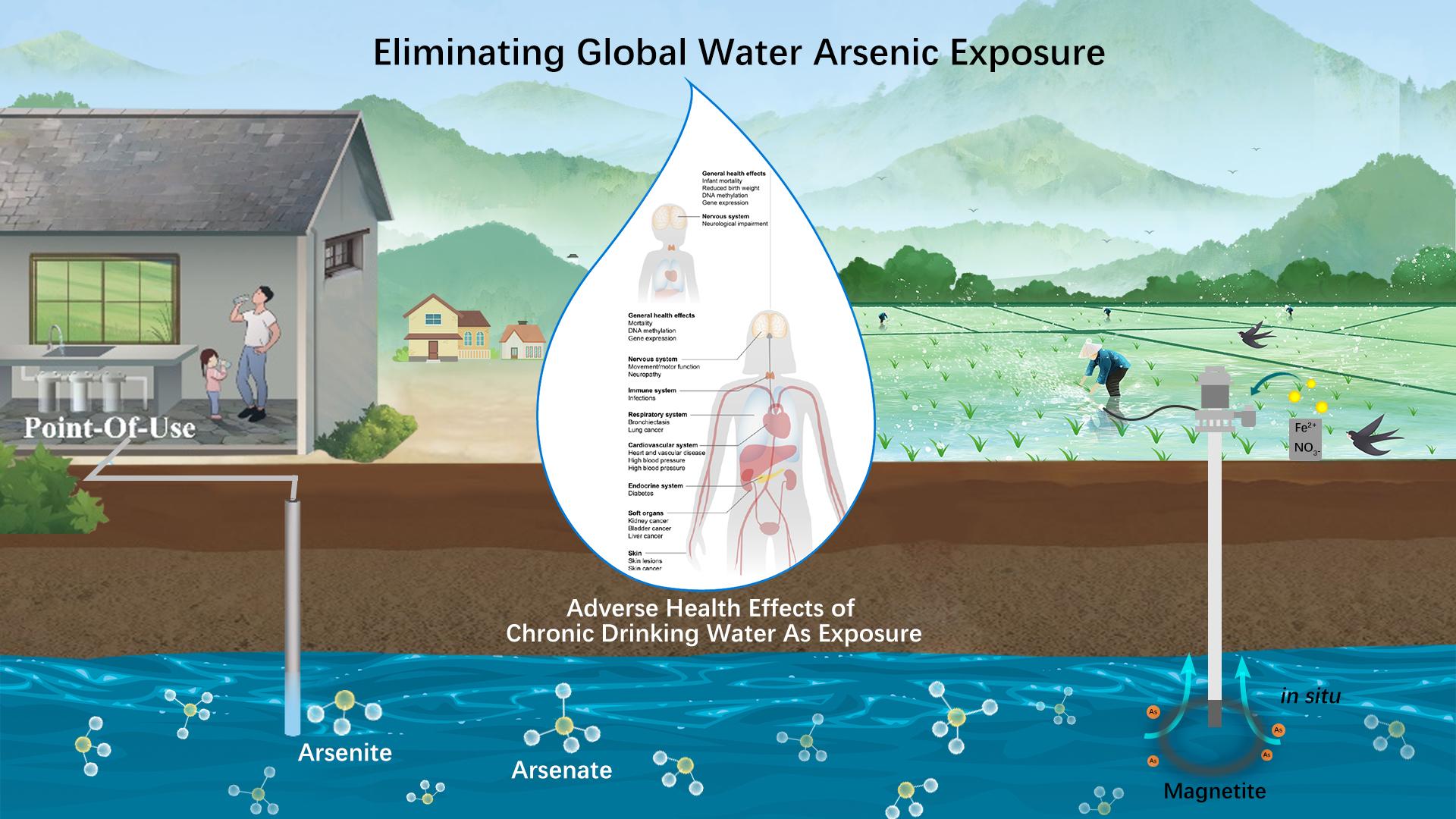
In a series of papers published in Nature Water, Environmental Science & Technology, ACS ES&T Water, and Journal of Environmental Sciences, Chair Professor Yan Zheng’s research team and collaborators have reported advances in household arsenic removal technology to purify drinking water, immobilization of groundwater arsenic in situ to purify irrigation water, as well as a portfolio of measurement techniques to facilitate on-site arsenic screening, and preservation and analysis of inorganic arsenic speciation. All are needed to tackle the global water arsenic crisis.
Key Finding 1: POU arsenic removal from well water
Millions of rural households which use groundwater for drinking are exposed to arsenic, which has dire health consequences. Efforts to reduce this exposure by water treatment have been a major focus in water research. At present, adsorbents can effectively remove arsenate from water, but their adsorption capacity for arsenite is relatively small. In community water treatment processes, arsenite is oxidized to arsenate with sodium hypochlorite prior to adsorption or coagulation treatment. However, it is not practical to use liquid oxidants in point-of-use (POU) filtration systems that are preferable for individual households.
The researchers demonstrated that removing arsenite and arsenate can be successful at the POU using an in-tandem configuration of three filters. The first filter consisted of solid oxidant manganese oxide-modified activated carbon (MnO2-AC). This was followed by granular nano-titanium oxide (GTO) to adsorb arsenic, and finally, a compressed activated carbon (AC) filter was used to remove any remaining particles.
Two POU units, built with components costing less than US $30, were deployed long-term in a suburban home in New Jersey and a rural home in China. These units supplied arsenic-safe water at a cost of less than US$0.01 per liter. This solution proved to be much cheaper than a point-of-entry (POE) unit, which usually costs thousands of dollars (Duan et al., 2024, Nature Water).
Key Finding 2: On-site inorganic arsenic screening methods
Rapid screening of inorganic arsenic in groundwater used for drinking by hundreds of millions of primarily rural residents worldwide is crucial for health protection (Zheng, 2020, Science). Most commercial field test kits are based on the Gutzeit reaction, costing an average of US$ 1.7 per test. These kits use mercury-based reagents for color development, an environmental concern that increasingly limits its utilization (He et al., 2023, JES).
Professor Zheng’s team further improved the molybdenum blue colorimetric method to allow for faster screening with more stable reagents. More importantly, a portable three-channel colorimeter was developed for screening inorganic arsenic on-site, with a low cost of US$ 0.35 per test. The improved chemical protocol lays the foundation for the molybdenum blue colorimetric method to become a commercially viable screening tool, with further engineering and design improvement of the colorimeter (Tuo et al., 2025, JES).
To select arsenic treatment media, it’s crucial to distinguish whether the arsenic is in the form of arsenite or arsenate. They discovered that adding EDTA to a final concentration of 20 mmol/L and storing samples in opaque bottles in the dark at 4°C showed the best performance in arsenic species preservation (Duan et al., 2024, ACS ES&T Water).
There is a pressing need for regulatory authorities to update the recommended sample preservation techniques in their standard methods (e.g., ISO/TS 19620, 2018) for arsenic speciation analysis. This update is essential to accommodate the variable groundwater chemistry and ensure the results are not misleading.
Key Finding 3: Immobilization of groundwater arsenic in situ
Geogenic arsenic contamination in groundwater is widespread, affecting drinking water and irrigation supplies globally, with food security and safety concerns on the rise. The researchers presented push-pull tests that demonstrated field-scale arsenic immobilization through the injection of small amounts of ferrous iron (Fe) and nitrate, which are readily available agricultural fertilizers. Such injections into an aquifer containing arsenic-rich (200 ± 52 μg/L) reducing groundwater led to the formation of a regenerable arsenic reactive filter in situ. This filter produced 15 m3 of groundwater, meeting the irrigation water quality standard of 50 μg/L at a low cost of US$ 0.08 per m3.
A reactive transport modeling approach was used to quantitatively evaluate the experimental observations and assess potential strategies for larger-scale implementation. The modeling results demonstrate that arsenic removal was primarily achieved by adsorption onto newly-formed minerals. An increased adsorption site density coincided with the finer-grained textures of the target aquifer.
Up-scaled model simulations, using 80-fold more Fe-nitrate reactants, indicated that enough arsenic-safe water could be produced. This water would be sufficient to irrigate 1000 m2 of arid land for one season of water-intense rice cultivation at a low cost. Importantly, this process would avoid undue contamination in surface soils, thereby safeguarding agricultural sustainability (Sun et al., 2024, ES&T).
Researchers from SUSTech involved in the mentioned papers include Chair Professor Yan Zheng, Research Assistant Professor Yanhua Duan, Research Assistant Professor Alejandro Palomo Gonzalez, Chair Professor Qingsong Liu, Associate Professor Fangyi Chen, Research Assistant Professor Yunjie Ma, Ph.D. students Zengyi Li, Jingyu Liu, and Yuxia Yang, master’s students Baoling Yang and Tianci Jiang, and visiting students Yuqin Sun and Xiaobao Tuo.
These works were supported by the National Natural Science Foundation of China (NSFC) and the National Key R&D Program.
Paper Links:
Nature Water, 2024, https://doi.org/10.1038/s44221-024-00268-9
Environmental Science & Technology, 2024, https://doi.org/10.1021/acs.est.4c03225
Journal of Environmental Science, 2025a, https://doi.org/10.1016/j.jes.2024.04.014
ACS ES&T Water, 2024, https://doi.org/10.1021/acsestwater.3c00619
Journal of Environmental Science, 2025b, https://doi.org/10.1016/j.jes.2024.01.036
Journal of Environmental Sciences, 2023, https://doi.org/10.1016/j.jes.2022.01.034
Science, 2020, https://www.science.org/doi/10.1126/science.abb9746
2026-03-10
2026-09-08
A delegation of 13 students from Southern University of Science and Technology (SUSTech), Zhejiang University and the University of Science and Technology of China (USTC), accompanied by four SUSTech faculty members including including two affiliated with the State Key Laboratory of Soil Pollution Control and Safety, concluded a 12-day summer school at Flinders University in August, 2026, hosted by the University’s National Centre for Groundwater Research and Training (NCGRT).Throughout the program, the students participated in a wide range of educational activities covering water resources, environmental health, groundwater modeling, managed aquifer recharge, salinity management, mining sites management, virtual reality hydrology, and nature-based solutions for surface water, groundwater and soil pollution.A highlight of the visit was a series of field trips showcasing South Australia’s unique natural environments. These included an overnight excursion to a global showcase of integrated surface and groundwater management exemplified by the Murray-Darling Basin. Visits to the St Kilda Mangroves highlighted ecohydrological approaches to coastal mangrove conservation. While Hallett Cove featured the most famous glacial striation on pre-Cambrian rocks. Happy Valley Reservoir, Oaklands Wetland, and Port Willunga Beach, with their wildlife, water management and well-exposed sedimentary rock formations, left strong impressions on our students. Students also attended research seminars and explored Flinders University’s teaching and research facilities.This summer school provided an excellent opportunity for students to engage with Flinders University staff, students, and researchers, experience Australian approaches to soil and groundwater pollution control and safety research, and strengthen the institutional ties between SUSTech and Flinders University, while fostering international connections and cross-cultural learning. The visit was made possible through a combination of support provided by SUSTech and the Fundamental and Interdisciplinary Disciplines Breakthrough Plan of the Ministry of Education of China(JYB2025XDXM909).During the visit, Chair Professor Yan ZHENG from SUSTech delivered a research seminar on arsenic detection in the developed and developing world. Flinders University noted that its academic community was privileged to learn from her expertise.SUSTech expresses its gratitude for the incredible partnership with Flinders University at the conclusion of the program.
2026-04-22
On April 22, the Frontiers Planet Prize announced its list of 25 National Champions for 2026. Hong WANG, a 2025 graduate of the School of Environmental Science and Engineering at the Southern Universi
2026-04-20
On the morning of April 17, 2026, a delegation from Flinders University (Australia), led by Professor Colin Stirling, President of Flinders University, visited the Southern University of Science and T
2026-04-08
Hydrological models are foundational tools for water resource management, agricultural planning, flood and drought mitigation, and ecosystem protection. A long-standing challenge in hydrology is devel
 |