

© 2026 All Rights Reserved. 粤ICP备14051456号
2024-06-25
View:21
With the intensification of human activities, CO2 emissions have surged, exacerbating the greenhouse effect and global warming. Carbon capture, utilization, and storage (CCUS) is considered the most effective and practical short-term solution for reducing CO2 emissions. According to the International Energy Agency, CCUS technology is expected to cumulatively capture 27 billion tons of CO2 by 2050. The development of novel, efficient CO2 capture materials is therefore of paramount importance.
In the quest for new materials, porous solid adsorbents have emerged at the forefront of next-generation carbon capture technology due to their non-corrosive nature and low regeneration energy consumption. Specifically, amine-functionalized adsorbents are suitable for various CO2 capture scenarios due to their high selectivity for CO2 and resistance to water vapor. However, these adsorbents still face challenges in practical applications, such as low adsorption efficiency and unstable cyclic performance. Thus, developing an efficient and stable CO2 capture material is crucial in addressing climate change challenges.
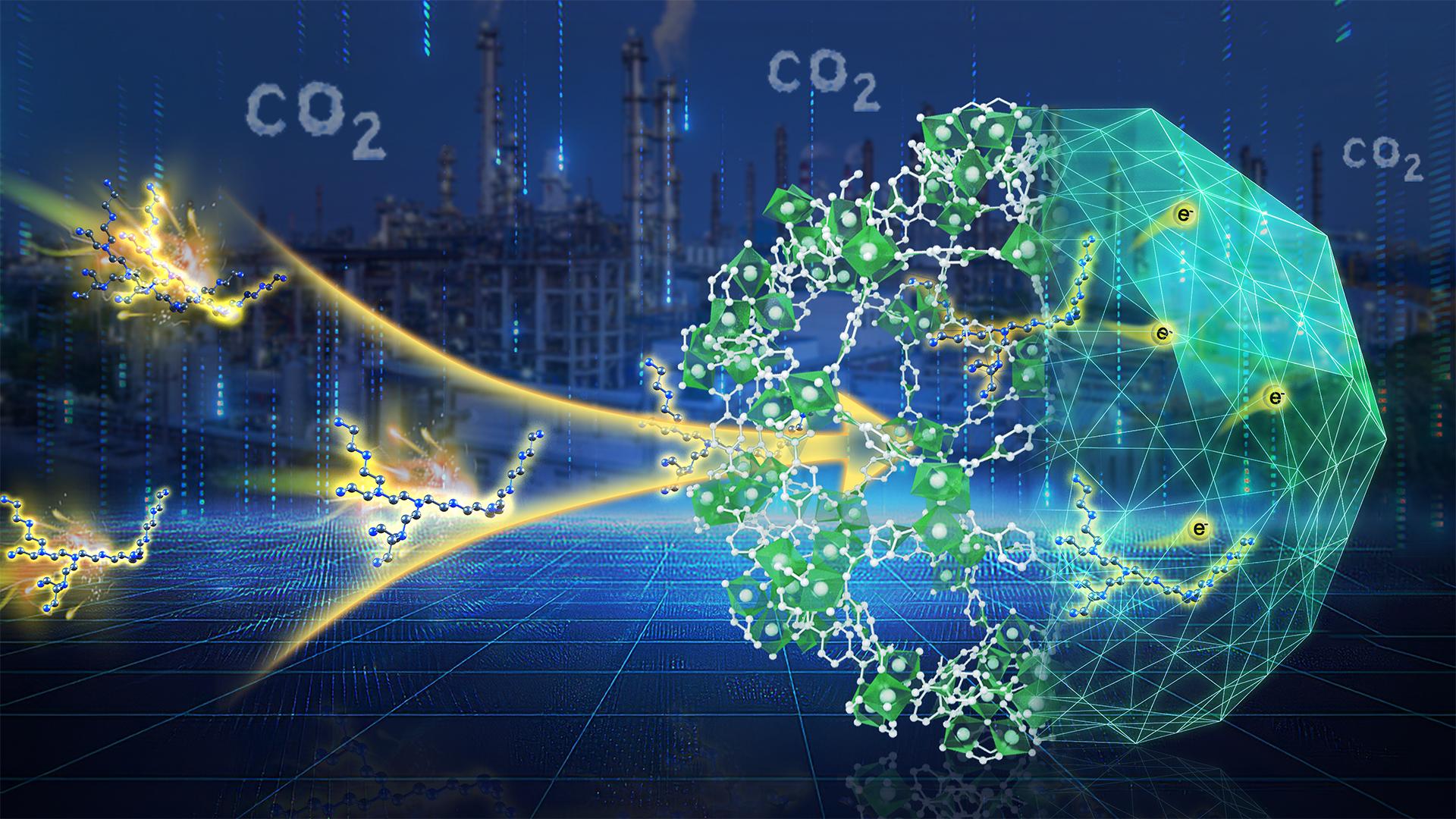
Professor Zuotai Zhang’s research team from the School of Environmental Science and Engineering at the Southern University of Science and Technology (SUSTech) has recently made a significant breakthrough in the field of CO2 capture. In their work, they introduced an innovative amine-support system that achieves efficient and stable CO2 capture, offering a new approach to the design of CO2 capture materials.
Their findings, entitled “Atom-level Interaction Design Between Amines and Support for Achieving Efficient and Stable CO2 Capture”, have been published in the prestigious journal Nature Communications.
The research team successfully synthesized a novel amine-support system based on atomic-level design. This system involves the precise impregnation of polyethyleneimine (PEI) molecules into the cage-like pores of MIL-101(Cr), forming strong coordination with the unsaturated chromium sites within, resulting in a stable composite material. This unique design not only achieves low regeneration energy (39.6 kJ/mol CO2) but also demonstrates excellent cyclic stability (only 0.18% decay per cycle under dry CO2 regeneration conditions), high CO2 adsorption capacity (4.0 mmol/g), and rapid adsorption kinetics (saturation achieved within 15 minutes at room temperature).
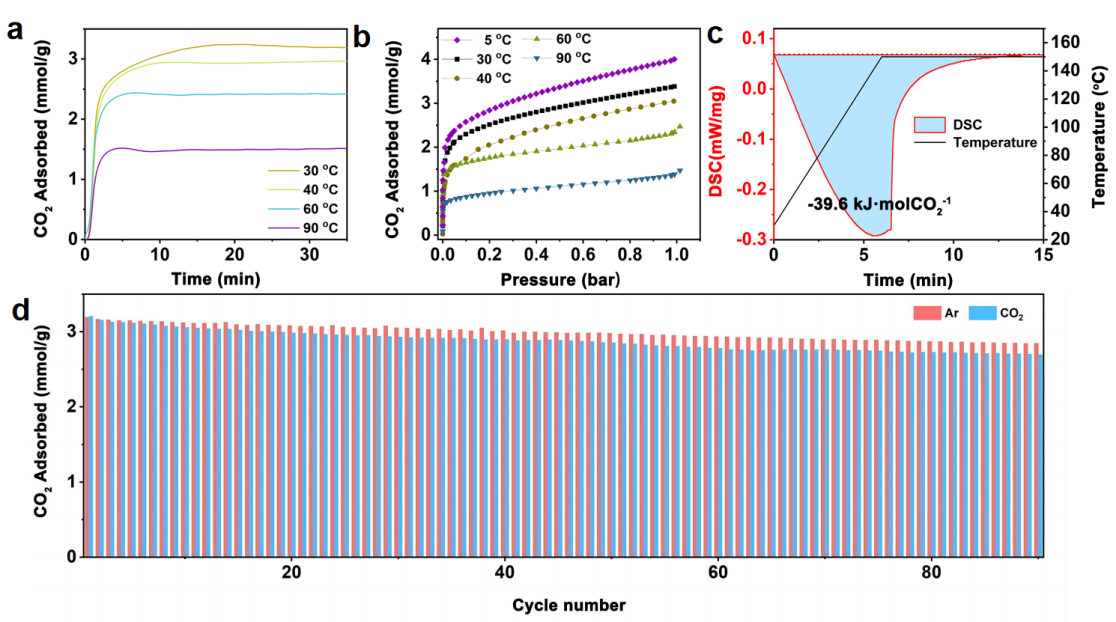
Figure 1. CO2 Capture performance of the novel amine-support system
Additionally, the study is the first to reveal the electronic-level interactions between amines and the support, preventing the dehydration reaction of carbamate products and significantly enhancing the material’s stability. The results indicate that this novel material has tremendous potential for CO2 capture, providing a feasible strategy for achieving low-cost, sustainable CO2 capture.
This work not only offers a new option for CO2 capture, but also provides essential references for future studies in environmental protection and energy conservation. The research team will continue to optimize and expand the carbon capture material system and explore its potential in practical industrial applications, contributing to global efforts to combat climate change.
Ph.D. candidate Xin Sun from Professor Zuotai Zhang’s group is the first author of the paper. Professors Zuotai Zhang and Xuehua Shen from SUSTech, and Hao Wang from Shenzhen Polytechnic University, are the co-corresponding authors. SUSTech is the first affiliated unit of the paper.
The study was supported by the National Natural Science Foundation of China (NSFC), Department of Science and Technology of Guangdong Province, and the Shenzhen Science and Technology Innovation Commission.
Paper link: https://www.nature.com/articles/s41467-024-48994-8
2026-03-10
2026-09-08
A delegation of 13 students from Southern University of Science and Technology (SUSTech), Zhejiang University and the University of Science and Technology of China (USTC), accompanied by four SUSTech faculty members including including two affiliated with the State Key Laboratory of Soil Pollution Control and Safety, concluded a 12-day summer school at Flinders University in August, 2026, hosted by the University’s National Centre for Groundwater Research and Training (NCGRT).Throughout the program, the students participated in a wide range of educational activities covering water resources, environmental health, groundwater modeling, managed aquifer recharge, salinity management, mining sites management, virtual reality hydrology, and nature-based solutions for surface water, groundwater and soil pollution.A highlight of the visit was a series of field trips showcasing South Australia’s unique natural environments. These included an overnight excursion to a global showcase of integrated surface and groundwater management exemplified by the Murray-Darling Basin. Visits to the St Kilda Mangroves highlighted ecohydrological approaches to coastal mangrove conservation. While Hallett Cove featured the most famous glacial striation on pre-Cambrian rocks. Happy Valley Reservoir, Oaklands Wetland, and Port Willunga Beach, with their wildlife, water management and well-exposed sedimentary rock formations, left strong impressions on our students. Students also attended research seminars and explored Flinders University’s teaching and research facilities.This summer school provided an excellent opportunity for students to engage with Flinders University staff, students, and researchers, experience Australian approaches to soil and groundwater pollution control and safety research, and strengthen the institutional ties between SUSTech and Flinders University, while fostering international connections and cross-cultural learning. The visit was made possible through a combination of support provided by SUSTech and the Fundamental and Interdisciplinary Disciplines Breakthrough Plan of the Ministry of Education of China(JYB2025XDXM909).During the visit, Chair Professor Yan ZHENG from SUSTech delivered a research seminar on arsenic detection in the developed and developing world. Flinders University noted that its academic community was privileged to learn from her expertise.SUSTech expresses its gratitude for the incredible partnership with Flinders University at the conclusion of the program.
2026-04-22
On April 22, the Frontiers Planet Prize announced its list of 25 National Champions for 2026. Hong WANG, a 2025 graduate of the School of Environmental Science and Engineering at the Southern Universi
2026-04-20
On the morning of April 17, 2026, a delegation from Flinders University (Australia), led by Professor Colin Stirling, President of Flinders University, visited the Southern University of Science and T
2026-04-08
Hydrological models are foundational tools for water resource management, agricultural planning, flood and drought mitigation, and ecosystem protection. A long-standing challenge in hydrology is devel
 |