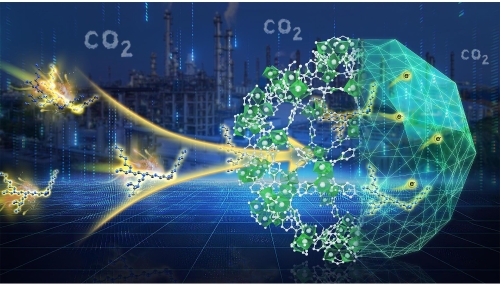
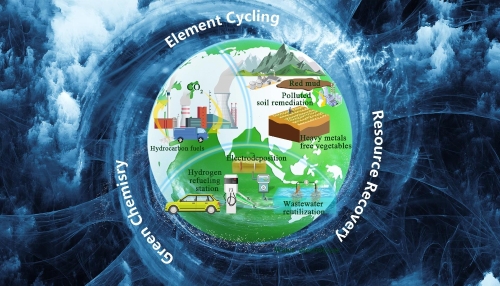
Associate Professor Hong Chen’s research team from the School of Environmental Science and Engineering at the Southern University of Science and Technology (SUSTech) has recently made a series of progress in resource recycling and pollution control chemistry. Their related results, involving CO2 valorization, closed-loop utilization of industrial wastewater, and red mud-driven soil remediation, have been published in renowned journals such as Nature Communications, Nano Letters, Green Chemistry, and ACS ES&T Engineering.Photocatalytic CO2 valorizationThe first paper, entitled “Unlocking Bimetallic Active Sites via a Desalination Strategy for Photocatalytic Reduction of Atmospheric Carbon,” was published in Nature Communications, a multidisciplinary journal covering high-quality research in all areas of the biological, health, physical, chemical, and Earth sciences.Developing high-efficiency photocatalysts for photocatalytic atmospheric CO2 reduction to hydrocarbon fuels plays a critical role in solving severe environmental pollution and climate change issues caused by the emission of CO2 and achieving the carbon neutrality goal for the development of a green and sustainable society.Prof. Chen’s research team have developed a novel top-down wet-chemistry desalination approach to remove the alkali-halide salt layer within the complicated precursor bulk structural matrix Pb0.6Bi1.4Cs0.6O2Cl2, and successfully fabricate a new 2D ultrathin bimetallic oxyhalide Pb0.6Bi1.4O2Cl1.4. The unlocked larger surface area, rich bimetallic active sites, and faster carrier dynamics within Pb0.6Bi1.4O2Cl1.4 layers significantly enhance the photocatalytic efficiency for atmospheric CO2 reduction. It outperforms the corresponding parental matrix phase and other state-of-the-art bismuth-based monometallic oxyhalides photocatalysts.This work reports a top-down desalination strategy for engineering ultrathin bimetallic 2D material for photocatalytic atmospheric CO2 reduction, which sheds light on further constructing other ultrathin 2D catalysts for environmental and energy applications from similar complicate structure matrixes.Xuezhen Feng, a doctoral student at SUSTech, and Renji Zheng, a postdoctoral fellow, are the co-first authors of this paper. Assoc. Prof. Hong Chen and Assoc. Prof. Xiaoyong Wu of the Wuhan University of Technology (WUT), are the co-corresponding authors, and SUSTech is the first unit of the paper.Figure 1. Desalination Strategy for unlocking bimetallic active sites for photocatalytic atmospheric CO2 reduction Electrocatalytic CO2 valorizationThe second paper, entitled “Bi2O3/BiO2 Nano-heterojunction for Highly Efficient Electrocatalytic CO2 Reduction to Formate,” was published in Nano Letters, a renowned high-impact academic journal in all areas of nanoscience and nanotechnology.Electrocatalytic CO2 conversion is also regarded as a prospective pathway for carbon resource recycling to generate sustainable fuels. The research team developed a novel Bi2O3/BiO2 heterojunction catalyst via a molten alkali-assisted dealumination strategy and exhibited fruitful structural dynamics during the electrocatalytic CO2 reduction reaction (ECO2RR) process. The as-synthesized Bi2O3/BiO2 heterostructure can be transformed into Bi/BiO2 during the ECO2RR process, thereby exhibiting enhanced adsorption of CO2 and *OCHO intermediate. Hence, the developed catalyst shows high selectivity towards formate (> 95%) and a high partial current density of −111.42 mA cm−2, benchmarked with the state-of-the-art Bi-based ECO2RR catalysts.This work provides a dynamic insight into the heterostructure electrocatalyst structure for ECO2RR, enabling a more rational design of efficient heterojunction electrocatalysts for ECO2RR and beyond.Xuezhen Feng and Haiyuan Zou, doctoral students, and Renji Zheng, a postdoctoral fellow, are the co-first authors of this paper. Assoc. Profs. Hong Chen and Lele Duan of SUSTech are the co-corresponding authors, and SUSTech is the only unit of the paper.Figure 2. Molten alkali-assisted dealumination strategy for constructing Bi2O3/BiO2 Nano-heterojunction for electrocatalytic CO2 reduction to formate Closed-loop utilization of industrial wastewaterThe third paper, entitled “Integrating electrodeposition with electrolysis for closing loop resource utilization of battery industrial wastewater,” was published in Green Chemistry, a high-impact academic journal covering sustainable chemistry and its implementation in chemical engineering.Synergistically recovering the critical elements, including metals and hydrogen, is highly demanded to innovate the modern industrial wastewater treatment technology via the lower carbon emission avenue.Prof. Chen's team demonstrated a facile metal recycling and wastewater resource reutilization routine via integrating electrodeposition and water electrolysis processes into battery industrial wastewater management. With a hierarchical nanoflower structure, the electrodeposited NiCoMn layered triple hydroxides are capable of catalyzing the post-electrodeposition (PE) wastewater splitting for hydrogen production, which outperforms the benchmark Pt/C||RuO2 counterpart.This study demonstrates an innovative strategy to simultaneously recycle critical metals together with molecular hydrogen from industrial wastewater. This paves the way for future industrial wastewater recycling and resource utilization from a low carbon emission and modern industrial ecology vision.Zhijie Chen, a visiting doctoral student from the University of Technology Sydney (UTS), is the first author of this paper. Assoc. Prof. Hong Chen and Prof. Bingjie Ni of the University of Technology Sydney (UTS) are the co-corresponding authors, and SUSTech is the first unit of the paper.Figure 3. Integrating electrodeposition with electrolysis for closing loop resource utilization of industrial wastewater Red mud-driven soil remediationThe fourth paper, entitled “Dual ions neutralized and stabilized red mud for chromium (VI) polluted soil remediation,” was published in ACS ES&T Engineering, a renowned academic journal covering all areas of environmental technology and engineering.Both alkaline heavy metal (HM) contaminated red mud (RM) recycling and Cr(VI) polluted soil remediation are severe hazardous environmental problems. The researchers developed a novel integrated approach to neutralize and stabilize the hazardous RM via the introduction of Ca2+ and Cl– dual ions.The pH neutralization is attributed to the novel OH– flocculation effect ascribing to Ca2+ charge neutralization and Cl– promoted proton neutralization. As the pH decreases, the HM adsorption capacity of RM is enhanced, achieving stable HM immobilization. The treated RM can be further employed to remediate Cr(VI) contaminated soil, which can suppress 56.0% Cr mobility in soil and 68.4% bioaccumulated Cr in the harvested vegetables.This study demonstrates an eco-friendly “waste-to-soil remediation” strategy to solve both the solid waste and soil pollution problems.Dazhong Yang, a postdoctoral fellow at SUSTech, is the first author of this paper. Assoc. Prof. Hong Chen is the corresponding author, and SUSTech is the only unit of the paper.Figure 4. Dual ions neutralized and stabilized red mud for Chromium(VI) polluted soil remediationThese studies were supported by the National Key Research and Development Program of China, National Natural Science Foundation of China (NSFC), Natural Science Funds for Distinguished Young Scholar of Guangdong Province, Foundation of Shenzhen Science and Technology Innovation Commission, Guangdong Basic and Applied Basic Research Foundation, Shenzhen Key Laboratory of Interfacial Science and Engineering of Materials, Youth Innovation Project of Guangdong Universities and Colleges, and the Shenzhen Key Laboratory of Interfacial Science and Engineering of Materials.The researchers acknowledge the efforts of Prof. Zuotai Zhang, Assoc. Prof. Shuping Yi, and Mrs. Juan Zhang, all of SUSTech, and Assoc. Prof. Yongfei Ji of Guangzhou University (GU), as well as group members Wenfei Wei, Ranhao Wang, Caiyan Gao, Jiangguli Peng, Songhe Yang, Zheting Chu, Shangying Li, Jing Li, Wensong Zou, and Qiuyue Ge. Additionally, they acknowledge the support of the SUSTech Core Research Facilities (SCRF), Test Center of the School of Environmental Science and Engineering, and Center for Computational Science and Engineering (CCSE). Paper links (In order of appearance above):Nature Communications: https://www.nature.com/articles/s41467-022-29671-0Nano Letters: https://pubs.acs.org/doi/10.1021/acs.nanolett.1c04683Green Chemistry: https://pubs.rsc.org/en/content/articlelanding/2022/gc/d1gc04891k#!ACS ES&T Engineering: https://pubs.acs.org/doi/10.1021/acsestengg.1c00420





[-]30094317_12313.jpg)











 |